
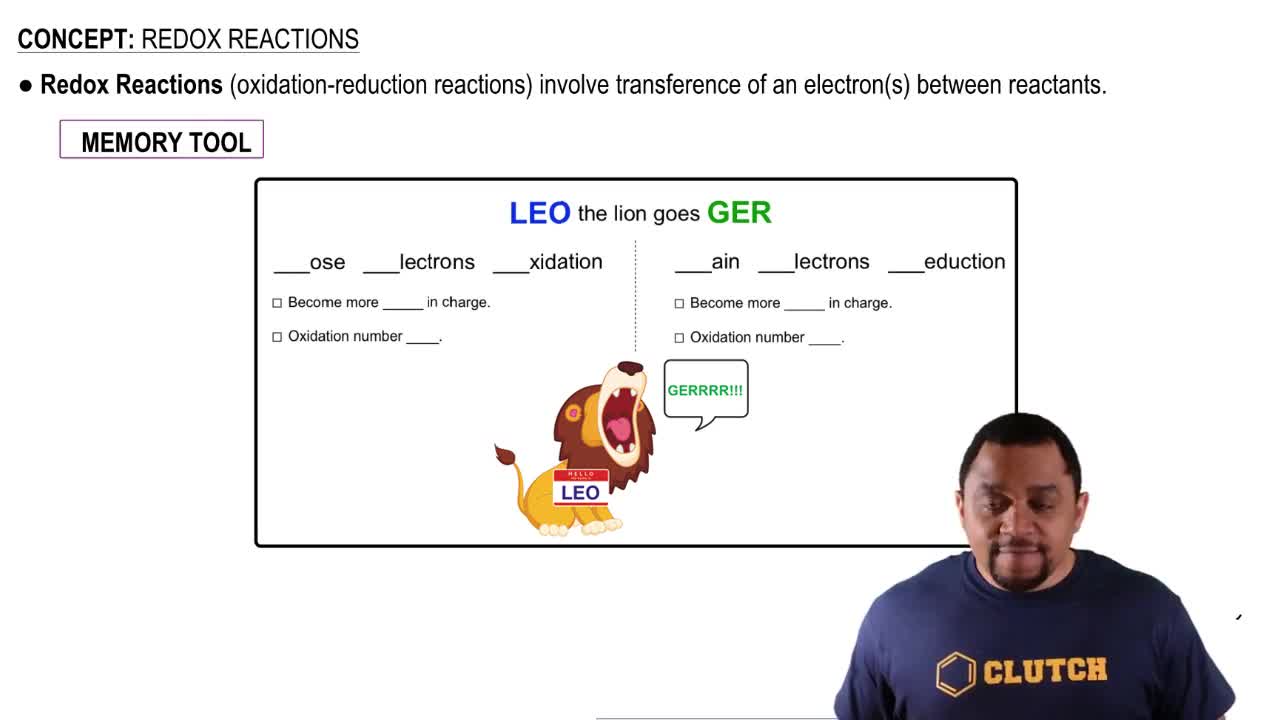
Which of the following are redox reactions? For those that are, indicate which element is oxidized and which is reduced. For those that are not, indicate whether they are precipitation or neutralization reactions. (a) P4(s) + 10 HClO(aq) + 6 H2O(l) → 4 H3PO4(aq) + 10 HCl(aq) (b) Br2(l) + 2 K(s)→ 2 KBr(s) (c) CH3CH2OH(l) + 3 O2(g) → 3 H2O(l) + 2 CO2(g) (d) ZnCl2(aq) + 2 NaOH(aq) → Zn(OH)2(s) + 2 NaCl(aq)
Ch.4 - Reactions in Aqueous Solution
Brown14th EditionChemistry: The Central ScienceISBN: 9780134414232Not the one you use?Change textbook
Chapter 4, Problem 51a
Which element is oxidized, and which is reduced in the following reactions? (a) N2(g) + 3 H2(g) → 2 NH3(g)
Verified step by step guidance1
Identify the oxidation states of each element in the reactants and products.
For N2, the oxidation state of nitrogen is 0 because it is in its elemental form.
For H2, the oxidation state of hydrogen is 0 because it is in its elemental form.
In NH3, the oxidation state of nitrogen is -3 and hydrogen is +1.
Determine which element's oxidation state increases (oxidation) and which decreases (reduction).

Verified video answer for a similar problem:
This video solution was recommended by our tutors as helpful for the problem above.
Video duration:
1mWas this helpful?
Key Concepts
Here are the essential concepts you must grasp in order to answer the question correctly.
Oxidation and Reduction
Oxidation and reduction are chemical processes that involve the transfer of electrons between substances. Oxidation refers to the loss of electrons, resulting in an increase in oxidation state, while reduction is the gain of electrons, leading to a decrease in oxidation state. These processes always occur simultaneously in a redox reaction.
Recommended video:
Guided course
Oxidation and Reduction Reactions
Oxidation States
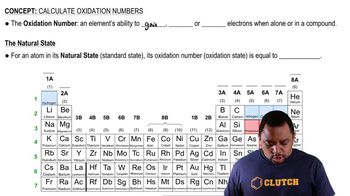
Oxidation states (or oxidation numbers) are assigned to atoms in a compound to indicate their degree of oxidation or reduction. The oxidation state helps in identifying which element is oxidized and which is reduced during a reaction. For example, in the reaction provided, determining the oxidation states of nitrogen and hydrogen will clarify their roles in the electron transfer.
Recommended video:
Guided course
Oxidation Numbers
Half-Reactions
Half-reactions are used to separate the oxidation and reduction processes in a redox reaction. Each half-reaction shows either the loss of electrons (oxidation) or the gain of electrons (reduction) for a specific species. Analyzing half-reactions can simplify the identification of which elements are oxidized and reduced in a given reaction.
Related Practice
Textbook Question
657
views
Textbook Question
Determine the oxidation number for the indicated element in each of the following substances: (e) Pt in PtCl4 (f) O in OF2.
519
views
Textbook Question
Which element is oxidized, and which is reduced in the following reactions? (c) Cl2(aq) + 2 NaI(aq) → I2(aq) + 2 NaCl(aq) (d) PbS(s) + 4 H2O2(aq) → PbSO4(s) + 4 H2O(l)
718
views
Textbook Question
Determine the oxidation number for the indicated element in each of the following substances: (d) N in HNO3
399
views
Textbook Question
Write balanced molecular and net ionic equations for the reactions of (a) manganese with dilute sulfuric acid (b) chromium with hydrobromic acid (c) tin with hydrochloric acid (d) aluminum with formic acid, HCOOH.
751
views
Textbook Question
Determine the oxidation number for the indicated element in each of the following substances: (f) Cl in NaClO4.
389
views
