Ch.5 - Thermochemistry
Brown - Chemistry: The Central Science 14th Edition
Brown14th EditionChemistry: The Central ScienceISBN: 9780134414232Not the one you use?Change textbook
Chapter 5, Problem 115

A 201-lb man decides to add to his exercise routine by walking up three flights of stairs (45 ft) 20 times per day. Hefigures that theworkrequired to increasehis potential energy in this way will permit him to eat an extra order of French fries, at 245 Cal, without adding to his weight. Is he correct in this assumption?

Verified step by step guidance
1
Convert the man's weight from pounds to kilograms using the conversion factor: 1 lb = 0.453592 kg.
Calculate the work done in one trip up the stairs using the formula for gravitational potential energy: \( \text{Work} = mgh \), where \( m \) is mass in kg, \( g \) is the acceleration due to gravity (9.8 m/s²), and \( h \) is the height in meters.
Convert the height from feet to meters using the conversion factor: 1 ft = 0.3048 m.
Calculate the total work done for 20 trips by multiplying the work done in one trip by 20.
Convert the total work from joules to calories using the conversion factor: 1 Cal = 4184 J, and compare it to 245 Cal to determine if the man can eat the extra order of French fries.

Key Concepts

Here are the essential concepts you must grasp in order to answer the question correctly.

Work and Energy

In physics, work is defined as the energy transferred when a force is applied over a distance. The work done against gravity to lift an object is calculated using the formula W = mgh, where W is work, m is mass, g is the acceleration due to gravity, and h is the height. Understanding this concept is crucial for determining the energy expenditure of the man as he walks up the stairs.
Recommended video:
Guided course
01:52
Work Function Calculation Example

Potential Energy

Potential energy is the energy stored in an object due to its position in a gravitational field. For an object at height h, the potential energy can be expressed as PE = mgh. In this scenario, the man increases his potential energy by ascending the stairs, which can be quantified to assess whether he can offset the caloric intake from the French fries.
Recommended video:
Guided course
00:34
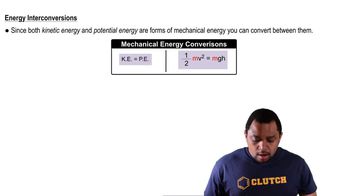
Kinetic & Potential Energy

Caloric Energy and Conversion

Calories are a unit of energy commonly used to quantify the energy content of food and the energy expenditure of physical activities. One dietary Calorie (Cal) is equivalent to 1,000 calories (cal). To determine if the man can eat an extra order of French fries without gaining weight, it is essential to compare the energy expended from climbing the stairs to the caloric value of the fries.
Recommended video:
Guided course
01:56
Conversion Factors
Related Practice
Textbook Question

From the following data for three prospective fuels, calculate which could provide the most energy per unit mass and per unit volume:

569
views

Textbook Question

Sucrose (C12H22O11) is produced by plants as follows: 12 CO2(g) + 11 H2O(l) → C12H22O11 + 12 O2(g) H = 5645 kJ About 4.8 g of sucrose is produced per day per square meter of the earth's surface. The energy for this endothermic reaction is supplied by the sunlight. About 0.1 % of the sunlight that reaches the earth is used to produce sucrose. Calculate the total energy the sun supplies for each square meter of surface area. Give your answer in kilowatts per square meter 1kW/m2 where 1W = 1 J/s2.

833
views
Textbook Question
When magnesium metal is burned in air (Figure 3.6), two products are produced. One is magnesium oxide, MgO. The other is the product of the reaction of Mg with molecular nitrogen, magnesium nitride. When water is added to magnesium nitride, it reacts to form magnesium oxide and ammonia gas. (e) The standard enthalpy of formation of solid magnesium nitride is -461.08 kJ>mol. Calculate the standard enthalpy change for the reaction between magnesium metal and ammonia gas.
2062
views
Textbook Question

At 25 °C (approximately room temperature) the rms velocity of an Ar atom in air is 1553 km/h. (c) What is the total kinetic energy of 1 mol of Ar atoms moving at this speed?

1
views
Textbook Question

At 20 °C (approximately room temperature) the average velocity of N2 molecules in air is 1050 mph. (b) What is the kinetic energy (in J) of an N2 molecule moving at this speed?

1356
views
1
comments