
Ch.5 - Thermochemistry
Brown - Chemistry: The Central Science 14th Edition
Brown14th EditionChemistry: The Central ScienceISBN: 9780134414232Not the one you use?Change textbook
Chapter 5, Problem 118c

At 25 °C (approximately room temperature) the rms velocity of an Ar atom in air is 1553 km/h. (c) What is the total kinetic energy of 1 mol of Ar atoms moving at this speed?

Verified step by step guidance
1
First, convert the rms velocity from km/h to m/s. Since 1 km/h is equal to 0.27778 m/s, multiply 1553 km/h by 0.27778 to get the velocity in m/s.
Use the formula for kinetic energy of a single particle: \( KE = \frac{1}{2} m v^2 \), where \( m \) is the mass of one Ar atom and \( v \) is the velocity in m/s. The mass of one Ar atom can be found using the molar mass of Ar (approximately 39.95 g/mol) and Avogadro's number (\( 6.022 \times 10^{23} \) atoms/mol).
Convert the molar mass of Ar from grams to kilograms by dividing by 1000, since 1 g = 0.001 kg. Then, calculate the mass of one Ar atom by dividing the molar mass in kg by Avogadro's number.
Substitute the mass of one Ar atom and the velocity in m/s into the kinetic energy formula to find the kinetic energy of one Ar atom.
Finally, multiply the kinetic energy of one Ar atom by Avogadro's number to find the total kinetic energy of 1 mol of Ar atoms moving at the given speed.

Verified video answer for a similar problem:

This video solution was recommended by our tutors as helpful for the problem above.
Video duration:
4m
Was this helpful?

Key Concepts

Here are the essential concepts you must grasp in order to answer the question correctly.

Root Mean Square Velocity (rms velocity)

The root mean square velocity is a measure of the average speed of particles in a gas. It is calculated using the formula v_rms = sqrt(3RT/M), where R is the ideal gas constant, T is the temperature in Kelvin, and M is the molar mass of the gas. This concept is crucial for understanding the kinetic energy of gas particles, as it relates directly to their motion and energy.

Kinetic Energy of Gas Particles

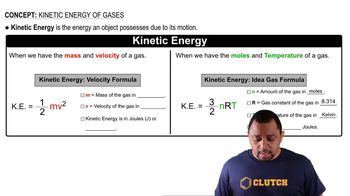
The kinetic energy of gas particles is given by the equation KE = (1/2)mv^2, where m is the mass of a particle and v is its velocity. For a mole of gas, the total kinetic energy can also be expressed as KE_total = (3/2)nRT, where n is the number of moles, R is the ideal gas constant, and T is the temperature. This relationship highlights how temperature and the number of particles influence the overall energy of a gas.
Recommended video:
Guided course
02:27
Kinetic Energy Formulas

Molar Mass

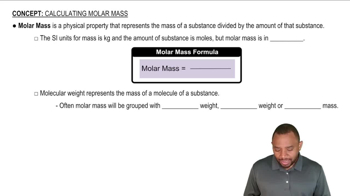
Molar mass is the mass of one mole of a substance, typically expressed in grams per mole (g/mol). For argon (Ar), the molar mass is approximately 40 g/mol. Understanding molar mass is essential for converting between the mass of a substance and the number of moles, which is necessary for calculating kinetic energy and other properties in gas laws.
Recommended video:
Guided course
02:11
Molar Mass Concept
Related Practice
Textbook Question

Consider the following unbalanced oxidation-reduction reactions in aqueous solution:

Ag+(aq) + Li(s) → Ag(s) + Li+(aq)

Fe(s) + Na+(aq) → Fe2+(aq) + Na(s)

K(s) + H2O(l) → KOH(aq) + H2(g)

(d) Use the activity series to predict which of these reactions should occur. (Section 4.4) Are these results in accord with your conclusion in part (c) of this problem?

Textbook Question

Sucrose (C12H22O11) is produced by plants as follows: 12 CO2(g) + 11 H2O(l) → C12H22O11 + 12 O2(g) H = 5645 kJ About 4.8 g of sucrose is produced per day per square meter of the earth's surface. The energy for this endothermic reaction is supplied by the sunlight. About 0.1 % of the sunlight that reaches the earth is used to produce sucrose. Calculate the total energy the sun supplies for each square meter of surface area. Give your answer in kilowatts per square meter 1kW/m2 where 1W = 1 J/s2.

833
views
Textbook Question

Suppose an Olympic diver who weighs 52.0 kg executes a straight dive from a 10-m platform. At the apex of the dive, the diver is 10.8 m above the surface of the water. (b) Assuming that all the potential energy of the diver is converted into kinetic energy at the surface of the water, at what speed, in m/s, will the diver enter the water?

592
views
Textbook Question

At 20 °C (approximately room temperature) the average velocity of N2 molecules in air is 1050 mph. (b) What is the kinetic energy (in J) of an N2 molecule moving at this speed?

1356
views
1
comments
Textbook Question

A 201-lb man decides to add to his exercise routine by walking up three flights of stairs (45 ft) 20 times per day. Hefigures that theworkrequired to increasehis potential energy in this way will permit him to eat an extra order of French fries, at 245 Cal, without adding to his weight. Is he correct in this assumption?

357
views