
Ch.5 - Thermochemistry
Brown - Chemistry: The Central Science 14th Edition
Brown14th EditionChemistry: The Central ScienceISBN: 9780134414232Not the one you use?Change textbook
Chapter 5, Problem 96

It is interesting to compare the 'fuel value' of a hydrocarbon in a hypothetical world where oxygen is not the combustion agent. The enthalpy of formation of CF4(g) is -679.9 kJ/mol. Which of the following two reactions is the more exothermic?
CH4(g) + 2 O2(g) → CO2(g) + 2 H2O(g)
CH4(g) + 4 F2(g) → CF4(g) + 4 HF(g)

Verified step by step guidance
1
Identify the two reactions given: (1) CH_4(g) + 2 O_2(g) \(\rightarrow\) CO_2(g) + 2 H_2O(g) and (2) CH_4(g) + 4 F_2(g) \(\rightarrow\) CF_4(g) + 4 HF(g).
For each reaction, calculate the enthalpy change (\(\Delta\) H) using the formula: \(\Delta\) H = \(\sum\) \(\Delta\) H_f(\(\text{products}\)) - \(\sum\) \(\Delta\) H_f(\(\text{reactants}\)).
For reaction (1), use standard enthalpies of formation: \(\Delta\) H_f(CO_2(g)) = -393.5 \(\text{ kJ/mol}\), \(\Delta\) H_f(H_2O(g)) = -241.8 \(\text{ kJ/mol}\), and \(\Delta\) H_f(CH_4(g)) = -74.8 \(\text{ kJ/mol}\). Assume \(\Delta\) H_f(O_2(g)) = 0.
For reaction (2), use the given \(\Delta\) H_f(CF_4(g)) = -679.9 \(\text{ kJ/mol}\) and \(\Delta\) H_f(HF(g)) = -268.6 \(\text{ kJ/mol}\). Assume \(\Delta\) H_f(F_2(g)) = 0 and \(\Delta\) H_f(CH_4(g)) = -74.8 \(\text{ kJ/mol}\).
Compare the calculated \(\Delta\) H values for both reactions to determine which is more exothermic (more negative \(\Delta\) H).

Verified video answer for a similar problem:

This video solution was recommended by our tutors as helpful for the problem above.
Video duration:
6m
Was this helpful?

Key Concepts

Here are the essential concepts you must grasp in order to answer the question correctly.

Enthalpy of Formation

The enthalpy of formation is the change in enthalpy when one mole of a compound is formed from its elements in their standard states. It is a crucial concept in thermodynamics, as it allows for the calculation of the overall energy change in chemical reactions. In this question, the enthalpy of formation of CF4(g) is provided, which will help determine the energy changes in the reactions involving methane.

Exothermic Reactions

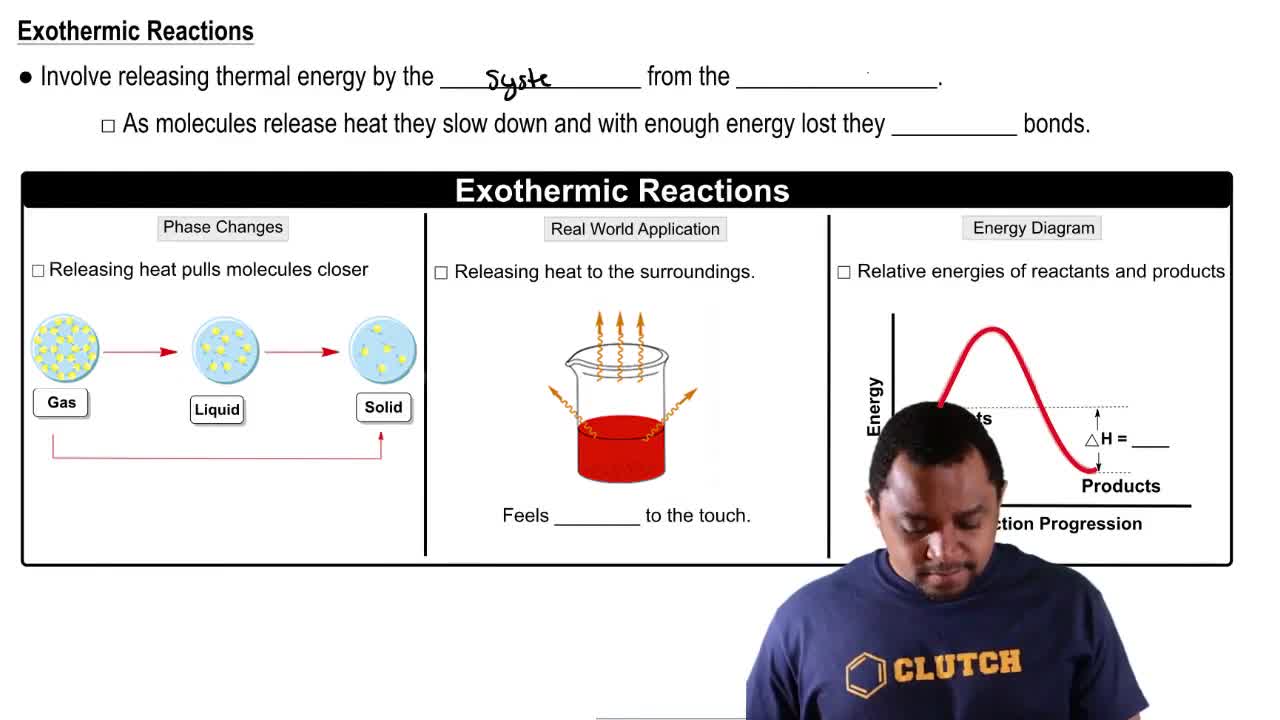
Exothermic reactions are chemical processes that release energy, usually in the form of heat, to the surroundings. This release of energy is often associated with the formation of stable products from less stable reactants. In the context of the question, comparing the two reactions will involve determining which one releases more energy, indicating a more exothermic nature.
Recommended video:
Guided course
02:38
Endothermic & Exothermic Reactions

Stoichiometry in Chemical Reactions

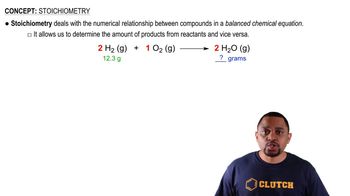
Stoichiometry is the calculation of reactants and products in chemical reactions based on the balanced chemical equation. It involves using mole ratios to relate the quantities of substances involved. In this question, stoichiometry will be essential for analyzing the two given reactions to determine the total energy changes and compare their exothermicity.
Recommended video:
Guided course
01:16
Stoichiometry Concept