
Ch.5 - Thermochemistry
Brown - Chemistry: The Central Science 14th Edition
Brown14th EditionChemistry: The Central ScienceISBN: 9780134414232Not the one you use?Change textbook
Chapter 5, Problem 95c

The standard enthalpies of formation of gaseous propyne (C3H4), propylene (C3H6), and propane (C3H8) are +185.4, +20.4, and -103.8 kJ/mol, respectively. (c) Which is the most efficient fuel in terms of heat evolved per unit mass?

Verified step by step guidance
1
Identify the molecular weights of propyne (C3H4), propylene (C3H6), and propane (C3H8). Calculate these by summing the atomic masses of carbon (12.01 g/mol) and hydrogen (1.008 g/mol) for each molecule.
Calculate the heat evolved per mole for each compound using their respective standard enthalpies of formation. Remember that a negative value indicates heat is released, thus a more negative value means more heat is evolved.
Convert the heat evolved per mole to heat evolved per gram for each compound. This is done by dividing the heat evolved per mole (from step 2) by the molecular weight (from step 1).
Compare the values obtained in step 3 for each compound. The compound with the highest negative value (or least positive value) per gram will be the most efficient fuel in terms of heat evolved per unit mass.
Conclude which compound is the most efficient fuel based on the calculations and comparisons made in the previous steps.

Verified video answer for a similar problem:

This video solution was recommended by our tutors as helpful for the problem above.
Video duration:
10m
Was this helpful?

Key Concepts

Here are the essential concepts you must grasp in order to answer the question correctly.

Enthalpy of Formation

The standard enthalpy of formation is the change in enthalpy when one mole of a compound is formed from its elements in their standard states. It provides insight into the stability of a compound; a lower (more negative) enthalpy indicates a more stable compound. In this context, it helps compare the energy content of different fuels.

Heat of Combustion

The heat of combustion is the amount of energy released when a substance is burned in oxygen. It is typically expressed in kJ/mol and is crucial for evaluating the efficiency of fuels. The higher the heat of combustion per unit mass, the more energy is available for work, making it a key factor in determining fuel efficiency.
Recommended video:
Guided course
02:24
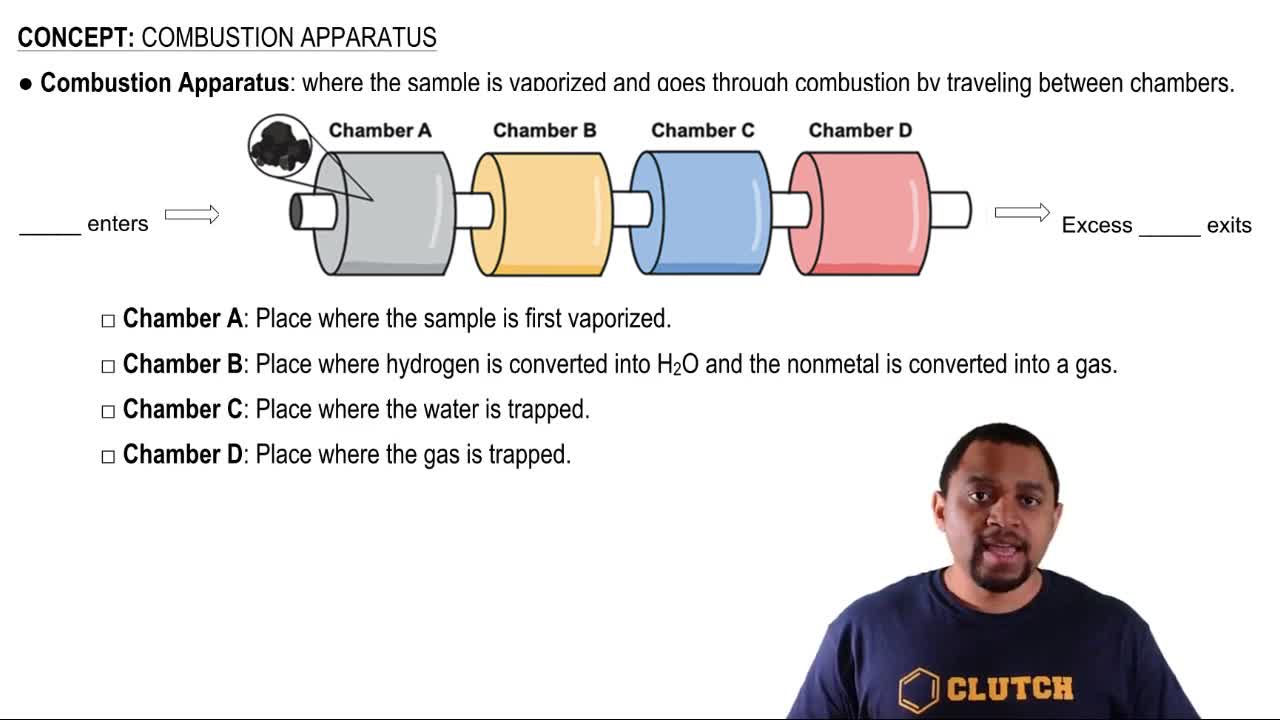
Combustion Apparatus

Energy Density

Energy density refers to the amount of energy stored in a given system or region of space per unit volume or mass. For fuels, it is often expressed in kJ/kg. Understanding energy density is essential for comparing fuels, as it indicates how much energy can be obtained from a specific mass, which is critical for applications in energy production and transportation.
Recommended video:
Guided course
01:56
Density Concepts