Ch.6 - Electronic Structure of Atoms
Brown - Chemistry: The Central Science 14th Edition
Brown14th EditionChemistry: The Central ScienceISBN: 9780134414232Not the one you use?Change textbook
Chapter 6, Problem 43b

One of the emission lines of the hydrogen atom has a wavelength of 94.974 nm. (b) Determine the initial and final values of n associated with this emission.

Verified step by step guidance
1
Identify the given wavelength of the emission line, which is 94.974 nm. Convert this wavelength into meters by multiplying by \(10^{-9}\), as 1 nm = \(10^{-9}\) meters.
Use the Rydberg formula for hydrogen emission, which is given by \(\frac{1}{\lambda} = R_H \left( \frac{1}{n_1^2} - \frac{1}{n_2^2} \right)\), where \(\lambda\) is the wavelength, \(R_H\) is the Rydberg constant (approximately \(1.097 \times 10^7 \, \text{m}^{-1}\)), \(n_1\) is the lower energy level, and \(n_2\) is the higher energy level.
Calculate \(\frac{1}{\lambda}\) using the converted wavelength in meters to find the inverse wavelength in meters\(^{-1}\).
Rearrange the Rydberg formula to solve for \(\left( \frac{1}{n_1^2} - \frac{1}{n_2^2} \right)\) by dividing the inverse wavelength by the Rydberg constant.
Estimate possible values of \(n_1\) and \(n_2\) that satisfy the equation \(\left( \frac{1}{n_1^2} - \frac{1}{n_2^2} \right)\). Typically, \(n_1\) will be a smaller integer (like 1 or 2) and \(n_2\) will be a larger integer. Check different combinations of \(n_1\) and \(n_2\) to see which pair fits the calculated value from the previous step.

Key Concepts

Here are the essential concepts you must grasp in order to answer the question correctly.

Hydrogen Emission Spectrum

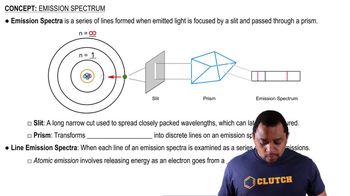
The hydrogen emission spectrum is a series of discrete wavelengths emitted by hydrogen atoms when electrons transition between energy levels. Each line in the spectrum corresponds to a specific transition, with the wavelength related to the energy difference between the initial and final states of the electron.
Recommended video:
Guided course
01:51
Emission Spectra

Energy Level Transitions

In an atom, electrons occupy quantized energy levels, denoted by the principal quantum number n. When an electron moves from a higher energy level (n_initial) to a lower one (n_final), it emits a photon with energy equal to the difference between these levels, which can be calculated using the Rydberg formula.
Recommended video:
Guided course
03:12
Transition Metals

Rydberg Formula

The Rydberg formula allows for the calculation of the wavelengths of spectral lines in hydrogen. It is expressed as 1/λ = R_H (1/n_final² - 1/n_initial²), where R_H is the Rydberg constant. This formula is essential for determining the initial and final quantum numbers associated with a given wavelength.
Recommended video:
Guided course
02:26
Skeletal Formula