Use the de Broglie relationship to determine the wavelengths of the following objects: (a) an 85-kg person skiing at 50 km/hr (b) a 10.0-g bullet fired at 250 m/s
Ch.6 - Electronic Structure of Atoms
Brown14th EditionChemistry: The Central ScienceISBN: 9780134414232Not the one you use?Change textbook
Chapter 6, Problem 46
Write the electron configurations for the following ions, anddetermine which have noble-gas configurations:(a) Ti2+(b) Br-(c) Mg2+(d) Po2-(e) Pt2+(f) V3+
Verified step by step guidance1
Identify the atomic number of each element from the periodic table. This will tell you the number of electrons in the neutral atom.
Adjust the number of electrons based on the charge of the ion. For cations (positive charge), subtract electrons; for anions (negative charge), add electrons.
Write the electron configuration for each ion using the adjusted electron count. Start filling from the lowest energy orbital (1s) and move to higher energy orbitals (2s, 2p, 3s, etc.) following the Aufbau principle, Hund's rule, and the Pauli exclusion principle.
Compare the electron configuration of each ion to the nearest noble gas configuration. Noble gases have complete outer shells, which generally means filled s and p orbitals in their highest occupied energy level.
Determine which ions have noble-gas configurations by checking if their electron configurations match exactly with that of any noble gas (He, Ne, Ar, Kr, Xe, Rn).

Verified video answer for a similar problem:
This video solution was recommended by our tutors as helpful for the problem above.
Video duration:
8mWas this helpful?
Key Concepts
Here are the essential concepts you must grasp in order to answer the question correctly.
Electron Configuration
Electron configuration describes the distribution of electrons in an atom's orbitals. It follows the Aufbau principle, which states that electrons fill the lowest energy orbitals first, and is represented using a notation that indicates the energy levels and sublevels occupied by electrons. Understanding how to write electron configurations is essential for predicting the chemical behavior of elements and their ions.
Recommended video:
Guided course
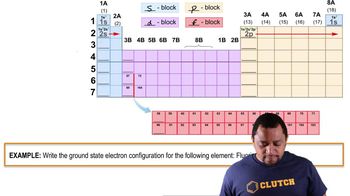
Electron Configuration Example
Ionic Charge and Electron Loss/Gain
Ionic charge refers to the net electrical charge an atom has after losing or gaining electrons to form an ion. For cations, such as Ti2+ and Mg2+, electrons are lost, resulting in a positive charge, while anions, like Br-, gain electrons, leading to a negative charge. Recognizing how to adjust the electron configuration based on the ionic charge is crucial for determining the final electron arrangement.
Recommended video:
Guided course
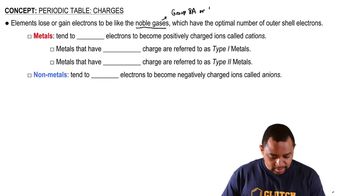
Ion Formation
Noble-Gas Configuration
Noble-gas configuration is a shorthand notation for electron configurations that reflects the stable electron arrangement of noble gases, which have full outer electron shells. Atoms and ions that achieve this configuration are typically more stable and less reactive. Identifying whether an ion has a noble-gas configuration helps in understanding its stability and reactivity in chemical reactions.
Recommended video:
Guided course
Noble Gas Compounds
Related Practice
Textbook Question
695
views
Textbook Question
Neutron diffraction is an important technique for determining the structures of molecules. Calculate the velocity of a neutron needed to achieve a wavelength of 125 pm. (Refer to the inside cover for the mass of the neutron.)
602
views
Textbook Question
The hydrogen atom can absorb light of wavelength 1094 nm. (a) In what region of the electromagnetic spectrum is this absorption found?
Textbook Question
One of the emission lines of the hydrogen atom has a wavelength of 94.974 nm. (b) Determine the initial and final values of n associated with this emission.
1897
views
1
comments
Textbook Question
Order the following transitions in the hydrogen atom from smallest to largest frequency of light absorbed: n = 3 to n = 7, n = 4 to n = 8, n = 2 to n = 5, and n = 1 to n = 3.
3445
views
Textbook Question
Among the elementary subatomic particles of physics is the muon, which decays within a few microseconds after formation. The muon has a rest mass 206.8 times that of an electron. Calculate the de Broglie wavelength associated with a muon traveling at 8.85 * 105 cm/s.
640
views