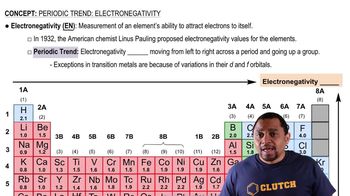
Using only the periodic table as your guide, select the most electronegative atom in each of the following sets: (a) Se, Te, Br, I; (b) Be, Mg, C, Si (c) Al, Si, P, S (d) Zn, Ge, Ga, As.
Ch.8 - Basic Concepts of Chemical Bonding
Brown14th EditionChemistry: The Central ScienceISBN: 9780134414232Not the one you use?Change textbook
Chapter 8, Problem 38
(a) What is the trend in electronegativity going from left to right in a row of the periodic table? (b) How do electronegativity values generally vary going down a column in the periodic table? (c) True or false: The most easily ionizable elements are the most electronegative.
Verified step by step guidance1
Step 1: Understand the concept of electronegativity, which is the ability of an atom to attract electrons in a chemical bond.
Step 2: Analyze the trend in electronegativity across a period (row) in the periodic table. Electronegativity generally increases from left to right across a period due to increasing nuclear charge and a constant shielding effect, which allows the nucleus to attract bonding electrons more strongly.
Step 3: Examine the trend in electronegativity down a group (column) in the periodic table. Electronegativity generally decreases as you move down a group because the additional electron shells increase the distance between the nucleus and the valence electrons, reducing the nucleus's ability to attract bonding electrons.
Step 4: Evaluate the statement: 'The most easily ionizable elements are the most electronegative.' Ionization energy is the energy required to remove an electron from an atom. Elements that are easily ionizable have low ionization energies and are typically metals, which are not highly electronegative. Therefore, the statement is false.
Step 5: Summarize the key points: Electronegativity increases across a period and decreases down a group, and the most easily ionizable elements are not the most electronegative.
Key Concepts
Here are the essential concepts you must grasp in order to answer the question correctly.
Electronegativity
Electronegativity is a measure of an atom's ability to attract and hold onto electrons in a chemical bond. It is a key factor in determining how atoms interact with each other, influencing bond polarity and molecular structure. The most commonly used scale for electronegativity is the Pauling scale, where values range from 0.7 (francium) to 4.0 (fluorine).
Recommended video:
Guided course
Electronegativity Trends
Periodic Trends
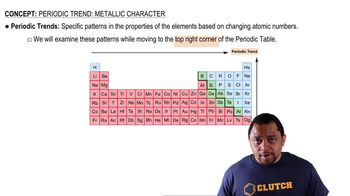
Periodic trends refer to predictable patterns observed in the properties of elements as one moves across a period (left to right) or down a group (top to bottom) in the periodic table. For electronegativity, it generally increases across a period due to increasing nuclear charge and decreases down a group due to increased distance from the nucleus and electron shielding.
Recommended video:
Guided course
Periodic Trends
Ionization Energy
Ionization energy is the energy required to remove an electron from an atom in its gaseous state. There is a relationship between ionization energy and electronegativity; typically, elements with high electronegativity also have high ionization energies. However, the statement that the most easily ionizable elements are the most electronegative is false, as these elements tend to be metals with low electronegativity.
Recommended video:
Guided course
Ionization Energy
Related Practice
Textbook Question
545
views
Textbook Question
(c) Would you expect the O—O bond in O2 to be shorter or longer than the O—O bond in compounds that contain an O—O single bond? Explain.
1
views
Textbook Question
(a) Construct a Lewis structure for hydrogen peroxide, H2O2, in which each atom achieves an octet of electrons.
2
views
Textbook Question
(b) How many bonding electrons are in the structure?
1021
views
Textbook Question
By referring only to the periodic table, select (d) the element in the group K, C, Zn, F that is most likely to form an ionic compound with Ba.
591
views
Textbook Question
By referring only to the periodic table, select (a) the most electronegative element in group 13; (b) the least electronegative element in the group As, Se and Br;