


The substance chlorine monoxide, ClO(g), is important in atmospheric processes that lead to depletion of the ozone layer. The ClO molecule has an experimental dipole moment of 1.24 D, and the Cl—O bond length is 160 pm. (c) Using formal charges as a guide, propose the dominant Lewis structure for the molecule. (g), is important in atmospheric processes that lead to depletion of the ozone layer. The ClO molecule has an experimental dipole moment of 1.24 D, and the Cl—O bond length is 160 pm. (d) The anion ClO exists. What is the formal charge on the Cl for the best Lewis structure for ClO-?
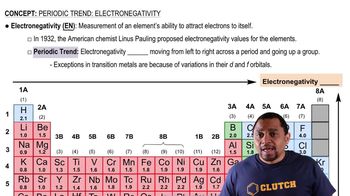
Consider the collection of nonmetallic elements O, P, Te, I, and B. (a) Which two would form the most polar single bond?
Verified step by step guidance
Verified video answer for a similar problem:
Key Concepts
Electronegativity
Polar vs. Nonpolar Bonds
Bonding Pairs and Molecular Geometry
Construct a Born–Haber cycle for the formation of the hypothetical compound NaCl2, where the sodium ion has a 2+ charge (the second ionization energy for sodium is given in Table 7.2). (a) How large would the lattice energy need to be for the formation of NaCl2 to be exothermic?
Consider the collection of nonmetallic elements: B, As, O, and I. (d) Which element would likely to participate in two covalent bonds?
The substance chlorine monoxide, ClO(g), is important in atmospheric processes that lead to depletion of the ozone layer. The ClO molecule has an experimental dipole moment of 1.24 D, and the Cl—O bond length is 160 pm. (b) Based on the electronegativities of the elements, which atom would you expect to have a partial negative charge in the ClO molecule?
