Ch.8 - Basic Concepts of Chemical Bonding
Brown - Chemistry: The Central Science 14th Edition
Brown14th EditionChemistry: The Central ScienceISBN: 9780134414232Not the one you use?Change textbook
Chapter 8, Problem 85d

Consider the collection of nonmetallic elements: B, As, O, and I. (d) Which element would likely to participate in two covalent bonds?

Verified step by step guidance
1
First, understand the concept of covalent bonding. Covalent bonds involve the sharing of electron pairs between atoms. Nonmetals typically form covalent bonds by sharing electrons to achieve a full valence shell, often resembling the electron configuration of noble gases.
Next, consider the valence electrons of each element. The number of covalent bonds an element can form is often related to the number of electrons needed to complete its valence shell. For example, oxygen (O) has 6 valence electrons and needs 2 more to complete its octet, making it likely to form two covalent bonds.
Examine the electron configuration of each element: - Boron (B) has 3 valence electrons. - Arsenic (As) has 5 valence electrons. - Oxygen (O) has 6 valence electrons. - Iodine (I) has 7 valence electrons.
Identify the element that needs two additional electrons to complete its valence shell. Oxygen, with 6 valence electrons, needs 2 more electrons to achieve a stable octet configuration, making it likely to form two covalent bonds.
Conclude that oxygen (O) is the element most likely to participate in two covalent bonds due to its need to gain two electrons to complete its octet.

Key Concepts

Here are the essential concepts you must grasp in order to answer the question correctly.

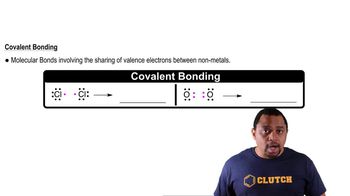
Covalent Bonding

Covalent bonding occurs when two atoms share one or more pairs of electrons, allowing them to achieve a more stable electron configuration. Nonmetals, which typically have high electronegativities, tend to form covalent bonds with other nonmetals. The number of covalent bonds an element can form is often determined by its valence electrons and its ability to share them with other atoms.
Recommended video:
Guided course
02:03
Chemical Bonds

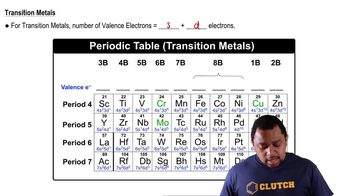
Valence Electrons

Valence electrons are the outermost electrons of an atom and are crucial in determining how an element interacts with others. The number of valence electrons influences an element's bonding behavior; for instance, elements with four or more valence electrons can form multiple covalent bonds. Understanding the valence electron configuration of the elements in question helps predict their bonding capabilities.
Recommended video:
Guided course
02:12
Transition Metals Valence Electrons

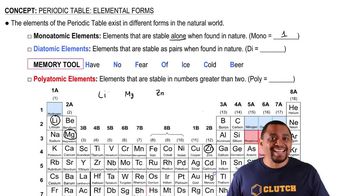
Nonmetallic Elements

Nonmetals are elements that typically lack the characteristics of metals, such as conductivity and malleability. They are found on the right side of the periodic table and often have high electronegativities, which allows them to form covalent bonds. Nonmetals like boron (B) and oxygen (O) can form multiple bonds due to their electron configurations, making them key players in covalent bonding scenarios.
Recommended video:
Guided course
02:35
Elemental Forms of Elements
Related Practice
Textbook Question

Consider the collection of nonmetallic elements O, P, Te, I, and B. (a) Which two would form the most polar single bond?

413
views

Textbook Question

The substance chlorine monoxide, ClO(g), is important in atmospheric processes that lead to depletion of the ozone layer. The ClO molecule has an experimental dipole moment of 1.24 D, and the Cl—O bond length is 160 pm. (c) Using formal charges as a guide, propose the dominant Lewis structure for the molecule. (g), is important in atmospheric processes that lead to depletion of the ozone layer. The ClO molecule has an experimental dipole moment of 1.24 D, and the Cl—O bond length is 160 pm. (d) The anion ClO exists. What is the formal charge on the Cl for the best Lewis structure for ClO-?

1
views
Textbook Question

Construct a Born–Haber cycle for the formation of the hypothetical compound NaCl2, where the sodium ion has a 2+ charge (the second ionization energy for sodium is given in Table 7.2). (a) How large would the lattice energy need to be for the formation of NaCl2 to be exothermic?

1103
views
Textbook Question

The substance chlorine monoxide, ClO(g), is important in atmospheric processes that lead to depletion of the ozone layer. The ClO molecule has an experimental dipole moment of 1.24 D, and the Cl—O bond length is 160 pm. (b) Based on the electronegativities of the elements, which atom would you expect to have a partial negative charge in the ClO molecule?

987
views
Textbook Question

(b) Using these partial charges and the atomic radii given in Figure 7.8, estimate the dipole moment of the molecule.

881
views