

Acetylene (C2H2) and nitrogen (N2) both contain a triple bond, but they differ greatly in their chemical properties. (b) By referring to Appendix C, look up the enthalpies of formation of acetylene and nitrogen. Which compound is more stable?
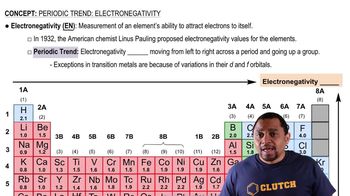
One scale for electronegativity is based on the concept that the electronegativity of any atom is proportional to the ionization energy of the atom minus its electron affinity: electronegativity = k(I - EA), where k is a proportionality constant. (d) Use your result from part (c) to determine the electronegativities of Cl and O using this scale. (e) Another scale for electronegativity defines electronegativity as the average of an atom’s first ionization energy and its electron affinity. Using this scale, calculate the electronegativities for the halogens, and scale them so that fluorine has an electronegativity of 4.0. On this scale, what is Br’s electronegativity?
Verified step by step guidanceKey Concepts
Electronegativity
Ionization Energy
Electron Affinity
(c) Hydrogen peroxide is sold commercially as an aqueous solution in brown bottles to protect it from light. Calculate the longest wavelength of light that has sufficient energy to break the weakest bond in hydrogen peroxide.
Consider the molecule C4H5N, which has the connectivity shown below. (a) After the Lewis structure for the molecule is completed, how many s and how many p bonds are there in this molecule?
The Ti2+ ion is isoelectronic with the Ca atom. (c) What charge would Ti have to be isoelectronic with Ca2+ ?
One scale for electronegativity is based on the concept that the electronegativity of any atom is proportional to the ionization energy of the atom minus its electron affinity: electronegativity = k1I - EA2, where k is a proportionality constant. (b) Why are both ionization energy and electron affinity relevant to the notion of electronegativity?
