

Acetylene (C2H2) and nitrogen (N2) both contain a triple bond, but they differ greatly in their chemical properties. (c) Write balanced chemical equations for the complete oxidation of N2 to form N2O5(g) and of acetylene to form CO2(g) and H2O(g). Write a balanced chemical equation for the complete oxidation of acetylene to form CO2(g) and H2O(g).
Ch.8 - Basic Concepts of Chemical Bonding
Brown14th EditionChemistry: The Central ScienceISBN: 9780134414232Not the one you use?Change textbook
Chapter 8, Problem 102b
One scale for electronegativity is based on the concept that the electronegativity of any atom is proportional to the ionization energy of the atom minus its electron affinity: electronegativity = k1I - EA2, where k is a proportionality constant. (b) Why are both ionization energy and electron affinity relevant to the notion of electronegativity?
Verified step by step guidance1
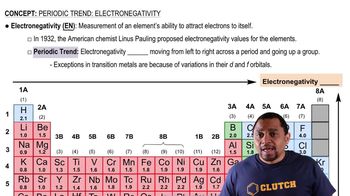
Step 1: Understand the concept of electronegativity. Electronegativity is a measure of the tendency of an atom to attract a bonding pair of electrons. The higher the electronegativity, the greater the atom's strength to attract a pair of electrons.
Step 2: Understand the concept of ionization energy. Ionization energy is the energy required to remove an electron from an atom or ion. The higher the ionization energy, the more difficult it is to remove an electron.
Step 3: Understand the concept of electron affinity. Electron affinity is the energy change that occurs when an electron is added to a neutral atom. The higher the electron affinity, the more readily the atom can accept an electron.
Step 4: Understand the relationship between these concepts. Both ionization energy and electron affinity are relevant to the notion of electronegativity because they both reflect the behavior of an atom in relation to electrons. An atom with a high ionization energy and a high electron affinity will have a high electronegativity because it strongly resists losing electrons and readily accepts additional electrons.
Step 5: Understand the equation. In the equation electronegativity = k1I - EA2, the ionization energy (I) and electron affinity (EA) are both taken into account. The constant k is a proportionality constant that adjusts the scale of the electronegativity values. This equation shows that electronegativity is directly proportional to ionization energy and inversely proportional to electron affinity.

Verified video answer for a similar problem:
This video solution was recommended by our tutors as helpful for the problem above.
Video duration:
3mWas this helpful?
Key Concepts
Here are the essential concepts you must grasp in order to answer the question correctly.
Ionization Energy
Ionization energy is the energy required to remove an electron from an atom in its gaseous state. It reflects how strongly an atom holds onto its electrons; higher ionization energy indicates a stronger attraction between the nucleus and the electrons. This concept is crucial for understanding electronegativity because atoms with high ionization energies tend to attract electrons more effectively, contributing to their electronegativity.
Recommended video:
Guided course
Ionization Energy
Electron Affinity
Electron affinity is the amount of energy released when an atom gains an electron to form a negative ion. It indicates how much an atom 'wants' to gain an electron; a higher electron affinity means the atom is more likely to attract additional electrons. This property is relevant to electronegativity as it helps determine how readily an atom can accept electrons, influencing its ability to form bonds with other atoms.
Electronegativity
Electronegativity is a measure of an atom's ability to attract and hold onto electrons in a chemical bond. It is influenced by both ionization energy and electron affinity, as these properties dictate how effectively an atom can gain or lose electrons. Understanding electronegativity is essential for predicting the behavior of atoms in chemical reactions and the nature of the bonds they form.
Recommended video:
Guided course
Electronegativity Trends
Related Practice
Textbook Question
350
views
Textbook Question
Acetylene (C2H2) and nitrogen (N2) both contain a triple bond, but they differ greatly in their chemical properties. (b) By referring to Appendix C, look up the enthalpies of formation of acetylene and nitrogen. Which compound is more stable?
344
views
Textbook Question
(c) Hydrogen peroxide is sold commercially as an aqueous solution in brown bottles to protect it from light. Calculate the longest wavelength of light that has sufficient energy to break the weakest bond in hydrogen peroxide.
Textbook Question
Consider the molecule C4H5N, which has the connectivity shown below. (a) After the Lewis structure for the molecule is completed, how many s and how many p bonds are there in this molecule?
918
views
