The concentration of H2O in the stratosphere is about 5 ppm. It undergoes photodissociation according to: H2O(g) → H(g) + OH(g) (b) Using Table 8.3, calculate the wavelength required to cause this dissociation.
Ch.18 - Chemistry of the Environment
Brown14th EditionChemistry: The Central ScienceISBN: 9780134414232Not the one you use?Change textbook
Chapter 18, Problem 86
A reaction that contributes to the depletion of ozone in the stratosphere is the direct reaction of oxygen atoms with ozone: O(g) + O3(g) → 2 O2(g). At 298 K, the rate constant for this reaction is 4.8 × 10⁵ M⁻¹ s⁻¹. Would you expect this reaction to occur via a single elementary process? Explain why or why not.
Verified step by step guidance1
Step 1: Understand the reaction given: O(g) + O3(g) → 2 O2(g). This reaction involves the collision of an oxygen atom with an ozone molecule to form two oxygen molecules.
Step 2: Consider the molecularity of the reaction. A single elementary process typically involves one or two reactant molecules colliding. This reaction involves two reactant species, which is consistent with a bimolecular elementary reaction.
Step 3: Evaluate the rate constant. The given rate constant is 4.8 × 10⁵ M⁻¹ s⁻¹, which is relatively high, suggesting that the reaction is likely to occur quickly if it is an elementary process.
Step 4: Consider the nature of the reactants. The reaction involves a highly reactive oxygen atom (O) and ozone (O3), both of which are capable of reacting quickly, supporting the idea of a direct, single-step process.
Step 5: Conclude based on the above analysis. Given the bimolecular nature, high rate constant, and reactive species involved, it is reasonable to expect that this reaction could occur via a single elementary process.
Key Concepts
Here are the essential concepts you must grasp in order to answer the question correctly.
Elementary Reactions
Elementary reactions are single-step processes that occur in a chemical reaction, where reactants directly convert to products without any intermediates. The rate of an elementary reaction is directly proportional to the concentration of the reactants raised to the power of their stoichiometric coefficients. Understanding whether a reaction is elementary helps in predicting its mechanism and rate law.
Recommended video:
Guided course
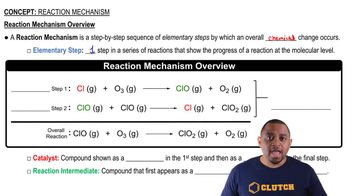
Reaction Mechanism Overview
Rate Constants and Reaction Order
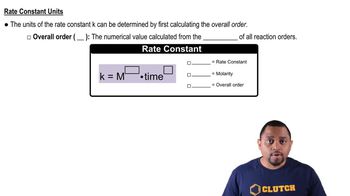
The rate constant (k) is a proportionality factor in the rate law of a reaction, which relates the reaction rate to the concentrations of reactants. The units of the rate constant depend on the overall order of the reaction. For the given reaction, the high rate constant suggests a fast reaction, but it does not necessarily indicate that the reaction occurs in a single elementary step.
Recommended video:
Guided course
Rate Constant Units
Mechanism of Reactions
The mechanism of a reaction describes the step-by-step sequence of elementary reactions that lead to the overall transformation of reactants into products. A reaction may involve multiple elementary steps, especially if it has a complex pathway or involves intermediates. Analyzing the mechanism is crucial for understanding the kinetics and dynamics of the reaction, particularly in cases like ozone depletion.
Recommended video:
Guided course
Reaction Mechanism Overview
Related Practice
Textbook Question
469
views
Textbook Question
The concentration of H2O in the stratosphere is about 5 ppm. It undergoes photodissociation according to: H2O(g) → H(g) + OH(g)
(c) The hydroxyl radical, OH, can react with ozone, giving the following reactions:
OH(g) + O3(g) → HO2(g) + O2(g)
HO2(g) + O(g) → OH(g) + O2(g)
What overall reaction results from these two elementary reactions? What is the catalyst in the overall reaction? Explain.
2
views
Textbook Question
The Henry's law constant for CO2 in water at 25 °C is 3.1x10^-2 M atm-1. (a) What is the soubility of CO2 in water at this temperature if the soltuion is in contact with air at normal atmospheric pressure?
13366
views
Textbook Question
The following data were collected for the desturction of O3 by H (O3 + H → O2 + OH) at very low concentrations (b) Calculate the rate constant
324
views