The precipitation of Al(OH)3 (Ksp) = 1.3⨉10-33) is sometimes used ot purify water. (a) Estimate the pH at which precipitation of Al(OH)3 will begin if 5.0 lb of Al2(SO4)3 is added to 2000 gal of water
Ch.18 - Chemistry of the Environment
Brown14th EditionChemistry: The Central ScienceISBN: 9780134414232Not the one you use?Change textbook
Chapter 18, Problem 87b
The following data were collected for the desturction of O3 by H (O3 + H → O2 + OH) at very low concentrations (b) Calculate the rate constant
Verified step by step guidance1
Identify the rate law for the reaction. Since the reaction is O_3 + H → O_2 + OH, the rate law can be expressed as rate = k[O_3][H], where k is the rate constant.
Use the experimental data provided to determine the rate of the reaction. This typically involves measuring the concentration of reactants over time.
Rearrange the rate law to solve for the rate constant k. This can be done by dividing the rate by the product of the concentrations of the reactants: k = rate / ([O_3][H]).
Substitute the measured rate and concentrations of O_3 and H into the rearranged rate law equation to calculate the value of the rate constant k.
Ensure that the units of the rate constant k are consistent with the order of the reaction. For a second-order reaction, the units of k are typically M^-1 s^-1.
Key Concepts
Here are the essential concepts you must grasp in order to answer the question correctly.
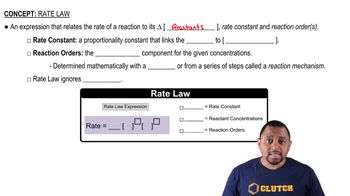
Rate Law
The rate law expresses the relationship between the rate of a chemical reaction and the concentration of its reactants. It is typically formulated as rate = k[A]^m[B]^n, where k is the rate constant, and m and n are the orders of the reaction with respect to each reactant. Understanding the rate law is essential for calculating the rate constant, especially in reactions involving low concentrations.
Recommended video:
Guided course
Rate Law Fundamentals
Order of Reaction
The order of a reaction refers to the power to which the concentration of a reactant is raised in the rate law. It indicates how the rate of reaction is affected by the concentration of that reactant. For example, a first-order reaction depends linearly on the concentration of one reactant, while a second-order reaction depends on the square of the concentration. Identifying the order is crucial for determining the rate constant from experimental data.
Recommended video:
Guided course
Average Bond Order
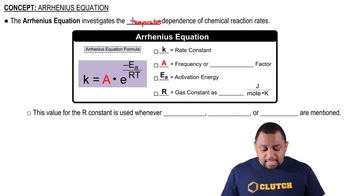
Arrhenius Equation
The Arrhenius equation relates the rate constant of a reaction to the temperature and activation energy. It is expressed as k = A * e^(-Ea/RT), where A is the pre-exponential factor, Ea is the activation energy, R is the gas constant, and T is the temperature in Kelvin. This equation helps in understanding how temperature influences the rate constant, which is particularly relevant when calculating k for reactions at varying temperatures.
Recommended video:
Guided course
Arrhenius Equation
Related Practice
Textbook Question
1648
views
Textbook Question
The concentration of H2O in the stratosphere is about 5 ppm. It undergoes photodissociation according to: H2O(g) → H(g) + OH(g)
(c) The hydroxyl radical, OH, can react with ozone, giving the following reactions:
OH(g) + O3(g) → HO2(g) + O2(g)
HO2(g) + O(g) → OH(g) + O2(g)
What overall reaction results from these two elementary reactions? What is the catalyst in the overall reaction? Explain.
2
views
Textbook Question
The Henry's law constant for CO2 in water at 25 °C is 3.1x10^-2 M atm-1. (a) What is the soubility of CO2 in water at this temperature if the soltuion is in contact with air at normal atmospheric pressure?
13366
views