Carry out the following operations and express the answers with the appropriate number of significant numbers. (c) (3.29×10⁴)(0.2501)
Ch.1 - Introduction: Matter, Energy, and Measurement

Brown15th EditionChemistry: The Central ScienceISBN: 9780137542970Not the one you use?Change textbook
Chapter 1, Problem 56c
Determine the appropriate conversion factors for the following: c. mi to km
Verified step by step guidance1
Identify the relationship between miles and kilometers. The conversion factor is 1 mile = 1.60934 kilometers.
Set up the conversion factor as a fraction. You can write it as \( \frac{1.60934 \text{ km}}{1 \text{ mi}} \) or \( \frac{1 \text{ mi}}{1.60934 \text{ km}} \), depending on the direction of conversion.
If converting from miles to kilometers, use the conversion factor \( \frac{1.60934 \text{ km}}{1 \text{ mi}} \).
Multiply the number of miles by the conversion factor to convert to kilometers.
Ensure that the units cancel appropriately, leaving you with the desired unit of kilometers.

Verified video answer for a similar problem:
This video solution was recommended by our tutors as helpful for the problem above.
Video duration:
1mWas this helpful?
Key Concepts
Here are the essential concepts you must grasp in order to answer the question correctly.
Unit Conversion
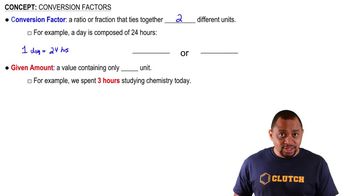
Unit conversion is the process of converting a quantity expressed in one set of units to another set of units. This is essential in chemistry and other sciences to ensure that measurements are consistent and comparable. It often involves multiplying by a conversion factor, which is a ratio that expresses how many of one unit are equal to another unit.
Recommended video:
Guided course
Conversion Factors
Conversion Factors
Conversion factors are specific ratios used to convert one unit of measurement to another. For example, to convert miles to kilometers, the conversion factor is 1 mile = 1.60934 kilometers. Understanding how to apply these factors correctly is crucial for accurate calculations in scientific contexts.
Recommended video:
Guided course
Conversion Factors
Dimensional Analysis
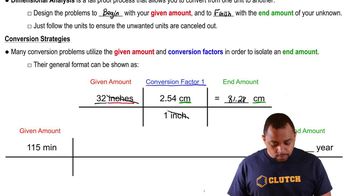
Dimensional analysis is a mathematical technique used to convert units by canceling out dimensions. It involves multiplying the quantity by conversion factors in such a way that the unwanted units cancel out, leaving the desired units. This method ensures that the final answer is in the correct unit and is a fundamental skill in chemistry for solving problems involving different units.
Recommended video:
Guided course
Dimensional Analysis
Related Practice
Textbook Question
387
views
Textbook Question
Carry out the following operations and express the answers in exponential notation with the appropriate number of significant figures.
a. 2.791×10⁴ + 8.76×10³
b. 4.67×10² − 5.4437×10⁴
c. (2.481×10⁻² + 7.33×10−4) × (1.924×10−2 + 6.70)
d. (1.3×10⁻⁴ − 3.746×10⁻²)/(1.3×102 − 3.746×10⁴)
Textbook Question
(b) The lung capacity of the blue whale is 5.0×10³ L. Convert this volume into gallons.
1127
views
Textbook Question
(d) Bamboo can grow up to 60.0 cm/day. Convert this growth rate into inches per hour.
838
views
Textbook Question
Determine the appropriate conversion factors for the following: d. ft3 to L
2
views
Textbook Question
You have a graduated cylinder that contains a liquid (see photograph). Write the volume of the liquid, in milliliters, using the proper number of significant figures.
989
views
3
comments