Carry out the following operations and express the answers with the appropriate number of significant numbers. (c) (3.29×10⁴)(0.2501)
Ch.1 - Introduction: Matter, Energy, and Measurement

Brown15th EditionChemistry: The Central ScienceISBN: 9780137542970Not the one you use?Change textbook
Chapter 1, Problem 54
You have a graduated cylinder that contains a liquid (see photograph). Write the volume of the liquid, in milliliters, using the proper number of significant figures.
Verified step by step guidance1
Identify the smallest graduation mark on the graduated cylinder to determine the scale of measurement.
Observe the meniscus of the liquid in the graduated cylinder. The meniscus is the curve seen at the top of a liquid in response to its container.
Read the volume at the bottom of the meniscus, ensuring your eye is level with the meniscus to avoid parallax error.
Determine the number of significant figures by considering the precision of the graduated cylinder's scale. Typically, you estimate one digit beyond the smallest graduation mark.
Record the volume of the liquid in milliliters, including the appropriate number of significant figures based on your estimation.

Verified video answer for a similar problem:
This video solution was recommended by our tutors as helpful for the problem above.
Video duration:
2mWas this helpful?
Key Concepts
Here are the essential concepts you must grasp in order to answer the question correctly.
Significant Figures
Significant figures are the digits in a number that contribute to its precision. This includes all non-zero digits, any zeros between significant digits, and trailing zeros in the decimal portion. Understanding significant figures is crucial for accurately reporting measurements in scientific contexts, as they reflect the precision of the measuring instrument used.
Recommended video:
Guided course
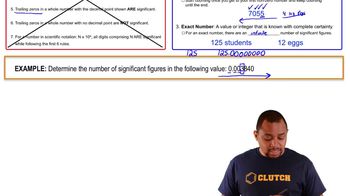
Significant Figures Example
Meniscus Reading
The meniscus is the curve at the surface of a liquid in a container, such as a graduated cylinder. When measuring the volume of a liquid, it is important to read the measurement at the bottom of the meniscus to ensure accuracy. This practice helps avoid parallax errors and ensures that the volume is recorded correctly.
Recommended video:
Guided course
Type of Binary Compound
Volume Measurement
Volume measurement refers to the quantification of the three-dimensional space occupied by a liquid. In a graduated cylinder, volume is typically measured in milliliters (mL) or liters (L). Understanding how to accurately measure and report volume is essential in chemistry, as it affects calculations in reactions, concentrations, and other quantitative analyses.
Recommended video:
Guided course
Units of Radiation Measurement
Related Practice
Textbook Question
387
views
Textbook Question
Carry out the following operations and express the answers in exponential notation with the appropriate number of significant figures.
a. 2.791×10⁴ + 8.76×10³
b. 4.67×10² − 5.4437×10⁴
c. (2.481×10⁻² + 7.33×10−4) × (1.924×10−2 + 6.70)
d. (1.3×10⁻⁴ − 3.746×10⁻²)/(1.3×102 − 3.746×10⁴)
Textbook Question
(b) The lung capacity of the blue whale is 5.0×10³ L. Convert this volume into gallons.
1127
views
Textbook Question
Carry out the following operations and express the answers with the appropriate number of significant numbers. (a) 14.3505 + 2.65 (b) 952.72 - 73.4201
550
views
Textbook Question
Determine the appropriate conversion factors for the following: c. mi to km
3
views
Textbook Question
Determine the appropriate conversion factors for the following: d. ft3 to L
2
views