
A watt is a measure of power (the rate of energy change) equal to 1 J/s. (b) An adult person radiates heat to the surroundings at about the same rate as a 100-watt electric incandescent light bulb. What is the total amount of energy in kcal radiated to the surroundings by an adult over a 24 h period?
Ch.1 - Introduction: Matter, Energy, and Measurement

Brown15th EditionChemistry: The Central ScienceISBN: 9780137542970Not the one you use?Change textbook
Chapter 1, Problem 84
Hexane 1density = 0.659 g/mL2 and acetic acid 1density = 1.0446 g/mL2 do not form a solution when mixed but separate into distinct layers. A piece of oak wood 1density = 900 kg/m32 is placed inside a test tube containing hexane and acetic acid; sketch how the three substances would position themselves.
Verified step by step guidance1
Step 1: Convert the density of oak wood from kg/m^3 to g/mL for consistency with the other substances. Use the conversion factor: 1 kg/m^3 = 0.001 g/mL.
Step 2: Compare the densities of hexane, acetic acid, and oak wood. Note that substances with lower density will float on substances with higher density.
Step 3: Determine the order of layers based on density. The substance with the lowest density will be on top, and the one with the highest density will be at the bottom.
Step 4: Sketch the test tube with three layers. Label the top layer as hexane, the middle layer as oak wood, and the bottom layer as acetic acid based on their densities.
Step 5: Explain that the oak wood will float on acetic acid but sink in hexane, positioning itself between the two liquids.
Key Concepts
Here are the essential concepts you must grasp in order to answer the question correctly.
Density
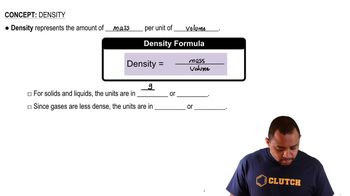
Density is defined as mass per unit volume, typically expressed in grams per milliliter (g/mL) or kilograms per cubic meter (kg/m³). It is a crucial property that determines how substances interact when mixed. In this scenario, the densities of hexane, acetic acid, and oak wood dictate their layering behavior when combined, as substances with lower density float on top of those with higher density.
Recommended video:
Guided course
Density Concepts
Immiscibility
Immiscibility refers to the inability of two substances to mix and form a homogeneous solution. In this case, hexane and acetic acid are immiscible due to their differing polarities; hexane is nonpolar while acetic acid is polar. This property results in the formation of distinct layers when the two liquids are combined, with each substance maintaining its own phase.
Buoyancy
Buoyancy is the upward force exerted by a fluid that opposes the weight of an object immersed in it. The buoyancy of the oak wood in the test tube is determined by its density relative to the densities of hexane and acetic acid. Since the density of oak wood (900 kg/m³) is greater than that of hexane but less than that of acetic acid, the wood will float on the acetic acid layer while being submerged in the hexane layer.
Related Practice
Textbook Question
1155
views
Textbook Question
Two spheres of equal volume are placed on the scales as shown. a. Which one is more dense?
407
views
Textbook Question
A 32.65-g sample of a solid is placed in a flask. Toluene, in which the solid is insoluble, is added to the flask so that the total volume of solid and liquid together is 50.00 mL. The solid and toluene together weigh 58.58 g. The density of toluene at the temperature of the experiment is 0.864 g/mL. What is the density of the solid?
1168
views
Textbook Question
Automobile batteries contain sulfuric acid, which is commonly referred to as “battery acid.” Calculate the number of grams of sulfuric acid in 1.00 gal of battery acid if the solution has a density of 1.28 g/mL and is 38.1% sulfuric acid by mass.
2
views
