The adult blue whale has a lung capacity of 5.0×10³ L. Calculate the mass of air (assume an average molar mass of 28.98 g/mol) contained in an adult blue whale’s lungs at 0.0°C and 1.00 atm, assuming the air behaves ideally.

Ch.10 - Gases

Brown15th EditionChemistry: The Central ScienceISBN: 9780137542970Not the one you use?Change textbook
Chapter 10, Problem 36
A neon sign is made of glass tubing whose inside diameter is 3.0 cm and length is 10.0 m. If the sign contains neon at a pressure of 265 Pa at 30 °C, how many grams of neon are in the sign? (The volume of a cylinder is πr²h.)
Verified step by step guidance1
Calculate the radius of the glass tubing by converting the diameter from centimeters to meters and then dividing by 2. Use the formula: radius (r) = diameter / 2.
Convert the length of the glass tubing from meters to centimeters to ensure consistent units when calculating volume.
Calculate the volume of the glass tubing using the formula for the volume of a cylinder: V = \(\pi\) r^2 h, where r is the radius and h is the height (or length) of the cylinder.
Use the ideal gas law, PV = nRT, to solve for the number of moles (n) of neon gas. Rearrange the formula to n = PV / RT, where P is pressure, V is volume, R is the ideal gas constant, and T is temperature in Kelvin.
Convert the number of moles of neon to grams using the molar mass of neon. Multiply the number of moles by the molar mass of neon (approximately 20.18 g/mol) to find the mass in grams.
Key Concepts
Here are the essential concepts you must grasp in order to answer the question correctly.
Ideal Gas Law
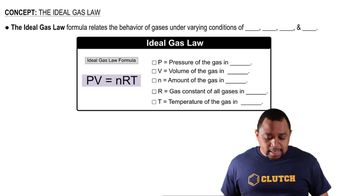
The Ideal Gas Law relates the pressure, volume, temperature, and number of moles of a gas through the equation PV = nRT. This law is essential for understanding how gases behave under different conditions and allows us to calculate the amount of gas present when given specific parameters like pressure and temperature.
Recommended video:
Guided course
Ideal Gas Law Formula
Volume of a Cylinder
The volume of a cylinder can be calculated using the formula V = πr²h, where r is the radius and h is the height (or length) of the cylinder. In this context, knowing the volume of the glass tubing is crucial for determining how much neon gas it can hold, which directly impacts the calculations using the Ideal Gas Law.
Recommended video:
Guided course
Constant-Volume Calorimetry
Molar Mass of Neon
The molar mass of neon is approximately 20.18 g/mol, which is necessary for converting the number of moles of neon gas (calculated from the Ideal Gas Law) into grams. Understanding molar mass allows for the final step in determining the total mass of neon contained in the sign, linking the gas properties to a tangible quantity.
Recommended video:
Guided course
Molar Mass Concept
Related Practice
Textbook Question
Textbook Question
Complete the following table for an ideal gas:
Textbook Question
Carbon dioxide makes up approximately 0.04% of Earth’s atmosphere. If you collect a 2.0-L sample from the atmosphere at sea level (1.00 atm) on a warm day (27°C), how many CO2 molecules are in your sample?
Textbook Question
If the pressure exerted by ozone, O3, in the stratosphere is 3.0×10⁻³atm and the temperature is 250 K, how many ozone molecules are in a liter?
Textbook Question
Suppose you are given two flasks at the same temperature, one of volume 2 L and the other of volume 3 L. The 2-L flask contains 4.8 g of gas, and the gas pressure is x atm. The 3-L flask contains 0.36 g of gas, and the gas pressure is 0.1x. Do the two gases have the same molar mass? If not, which contains the gas of higher molar mass?