
Textbook Question
The adult blue whale has a lung capacity of 5.0×10³ L. Calculate the mass of air (assume an average molar mass of 28.98 g/mol) contained in an adult blue whale’s lungs at 0.0°C and 1.00 atm, assuming the air behaves ideally.

 Verified step by step guidance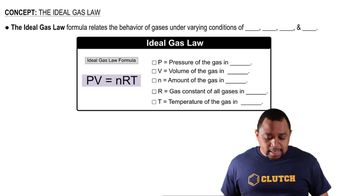
 01:15
01:15
 03:48
03:48 02:52
02:52The adult blue whale has a lung capacity of 5.0×10³ L. Calculate the mass of air (assume an average molar mass of 28.98 g/mol) contained in an adult blue whale’s lungs at 0.0°C and 1.00 atm, assuming the air behaves ideally.
Complete the following table for an ideal gas:
If the pressure exerted by ozone, O3, in the stratosphere is 3.0×10⁻³atm and the temperature is 250 K, how many ozone molecules are in a liter?
Suppose you are given two flasks at the same temperature, one of volume 2 L and the other of volume 3 L. The 2-L flask contains 4.8 g of gas, and the gas pressure is x atm. The 3-L flask contains 0.36 g of gas, and the gas pressure is 0.1x. Do the two gases have the same molar mass? If not, which contains the gas of higher molar mass?
Suppose you are given two 1-L flasks and told that one contains a gas of molar mass 30 and the other a gas of molar mass 60, both at the same temperature. The pressure in flask A is x atm, and the mass of gas in the flask is 1.2 g. The pressure in flask B is 0.5x atm, and the mass of gas in that flask is 1.2 g. Which flask contains the gas of molar mass 30, and which contains the gas of molar mass 60?