
Ch.10 - Gases
Brown - Chemistry: The Central Science 15th Edition
Brown15th EditionChemistry: The Central ScienceISBN: 9780137542970Not the one you use?Change textbook
Chapter 10, Problem 9b

Consider the following graph. (b) If A and B refer to the same gas at two different temperatures, which represents the higher temperature?

Verified step by step guidance
1
Identify the axes of the graph. Typically, a graph involving gases will have pressure (P) on the y-axis and volume (V) on the x-axis.
Recall the ideal gas law: PV = nRT, where T is the temperature. For a given amount of gas (n) and constant R, the relationship between P and V at different temperatures can be analyzed.
Understand that at higher temperatures, the gas molecules have more kinetic energy, which affects the pressure and volume relationship.
Recognize that for the same gas at different temperatures, the curve representing the higher temperature will be further from the origin in a PV graph. This is because at higher temperatures, for the same volume, the pressure is higher.
Determine which curve (A or B) is further from the origin, indicating it represents the higher temperature.

Verified video answer for a similar problem:

This video solution was recommended by our tutors as helpful for the problem above.
Video duration:
1m
Was this helpful?

Key Concepts

Here are the essential concepts you must grasp in order to answer the question correctly.

Gas Laws

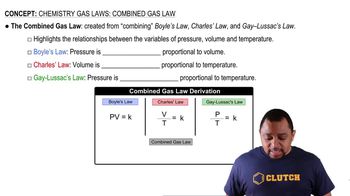
Gas laws describe the behavior of gases in relation to pressure, volume, and temperature. The most relevant laws include Boyle's Law, Charles's Law, and the Ideal Gas Law, which collectively explain how changes in temperature affect gas properties. Understanding these laws is crucial for interpreting graphs that depict gas behavior under varying conditions.
Recommended video:
Guided course
01:43
Combined Gas Law

Temperature and Kinetic Energy

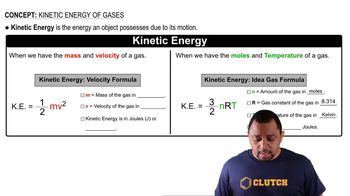
Temperature is a measure of the average kinetic energy of the particles in a substance. In gases, higher temperatures correspond to greater kinetic energy, leading to increased particle movement. This relationship is fundamental when comparing the states of a gas at different temperatures, as it directly influences pressure and volume.
Recommended video:
Guided course
02:27
Kinetic Energy Formulas

Graph Interpretation

Interpreting graphs involves analyzing the plotted data to extract meaningful information. In the context of gas behavior, a graph may show temperature on one axis and another variable (like pressure or volume) on the other. Understanding how to read these graphs is essential for determining which conditions correspond to higher or lower temperatures based on the data presented.
Recommended video:
Guided course
03:13
Intepreting the Band of Stability
Related Practice
Textbook Question

A thin glass tube 1 m long is filled with Ar gas at 101.3 kPa, and the ends are stoppered with cotton plugs as shown below. HCl gas is introduced at one end of the tube, and simultaneously NH3 gas is introduced at the other end. When the two gases diffuse through the cotton plugs down the tube and meet, a white ring appears due to the formation of NH4Cl1s2. At which location—a, b, or c—do you expect the ring to form?

688
views
1
rank
Textbook Question

The graph below shows the change in pressure as the temperature increases for a 1-mol sample of a gas confined to a 1-L container. The four plots correspond to an ideal gas and three real gases: CO2, N2, and Cl2. (a) At room temperature, all three real gases have a pressure less than the ideal gas. Which van der Waals constant, a or b, accounts for the influence intermolecular forces have in lowering the pressure of a real gas?

716
views
Textbook Question

Consider the following samples of gases:

If the three samples are all at the same temperature, rank them with respect to (c) density

431
views
Textbook Question

The apparatus shown here has two gas-filled containers and one empty container, all attached to a hollow horizontal tube closed at both ends.

a. How many blue gas molecules are in the left container?

b. How many red gas molecules are in the middle container?

c. When the valves are opened and the gases are allowed to mix at constant temperature, how many atoms of each type of gas end up in the originally empty container? Assume that the containers are of equal volume and ignore the volume of the connecting tube. [Section 10.4]

Textbook Question

You have a sample of gas in a container with a movable piston, such as the one in the drawing. b. Redraw the container to show what it might look like if the external pressure on the piston is increased from 1.0 atm to 2.0 atm while the temperature is kept constant.

2
views