
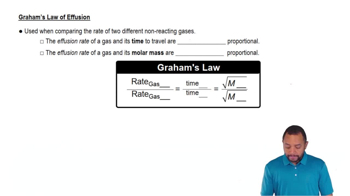
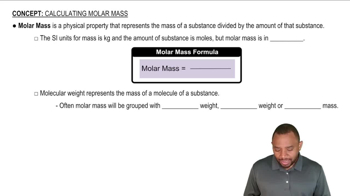
A thin glass tube 1 m long is filled with Ar gas at 101.3 kPa, and the ends are stoppered with cotton plugs as shown below. HCl gas is introduced at one end of the tube, and simultaneously NH3 gas is introduced at the other end. When the two gases diffuse through the cotton plugs down the tube and meet, a white ring appears due to the formation of NH4Cl1s2. At which location—a, b, or c—do you expect the ring to form?

Suppose you have two 1-L flasks, one containing N2 at STP, the other containing CH4 at STP. How do these systems compare with respect to (d) the rate of effusion through a pinhole leak?
Verified step by step guidanceKey Concepts
Graham's Law of Effusion
Molar Mass
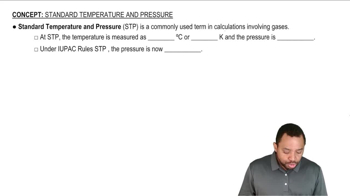
Standard Temperature and Pressure (STP)
Consider the following graph. (b) If A and B refer to the same gas at two different temperatures, which represents the higher temperature?
Consider the following samples of gases:
If the three samples are all at the same temperature, rank them with respect to (c) density
The apparatus shown here has two gas-filled containers and one empty container, all attached to a hollow horizontal tube closed at both ends.
a. How many blue gas molecules are in the left container?
b. How many red gas molecules are in the middle container?
c. When the valves are opened and the gases are allowed to mix at constant temperature, how many atoms of each type of gas end up in the originally empty container? Assume that the containers are of equal volume and ignore the volume of the connecting tube. [Section 10.4]
You have a sample of gas in a container with a movable piston, such as the one in the drawing. b. Redraw the container to show what it might look like if the external pressure on the piston is increased from 1.0 atm to 2.0 atm while the temperature is kept constant.
