

At standard temperature and pressure, the molar volumes of Cl2 and NH3 gases are 22.06 and 22.40 L, respectively. (c) The densities of crystalline Cl2 and NH3 at 160 K are 2.02 and 0.84 g/cm3, respectively. Calculate their molar volumes.
Ch.11 - Liquids and Intermolecular Forces

Brown15th EditionChemistry: The Central ScienceISBN: 9780137542970Not the one you use?Change textbook
Chapter 11, Problem 12a
(a) How does the average kinetic energy of molecules com- pare with the average energy of attraction between mole- cules in solids, liquids, and gases?
Verified step by step guidance1
1. The average kinetic energy of molecules is a measure of how fast the molecules are moving. This energy is related to the temperature of the substance. The higher the temperature, the higher the average kinetic energy of the molecules.
2. The average energy of attraction between molecules, also known as intermolecular forces, is a measure of how strongly the molecules are attracted to each other. This energy is related to the phase of the substance. In solids, the intermolecular forces are strong enough to keep the molecules in a fixed position. In liquids, the intermolecular forces are weaker, allowing the molecules to slide past each other. In gases, the intermolecular forces are very weak or negligible, allowing the molecules to move freely.
3. In solids, the average energy of attraction between molecules is greater than the average kinetic energy of the molecules. This is why the molecules are held in a fixed position.
4. In liquids, the average kinetic energy of the molecules is comparable to the average energy of attraction between molecules. This is why the molecules can slide past each other but are still held together to some extent.
5. In gases, the average kinetic energy of the molecules is much greater than the average energy of attraction between molecules. This is why the molecules can move freely and are not held together.

Verified video answer for a similar problem:
This video solution was recommended by our tutors as helpful for the problem above.
Video duration:
1mWas this helpful?
Key Concepts
Here are the essential concepts you must grasp in order to answer the question correctly.
Kinetic Molecular Theory
The Kinetic Molecular Theory explains the behavior of gases in terms of the motion of their molecules. It posits that gas molecules are in constant, random motion and that the temperature of a gas is directly proportional to the average kinetic energy of its molecules. This theory helps to understand how kinetic energy varies in solids, liquids, and gases, influencing their physical properties.
Recommended video:
Guided course
Kinetic Molecular Theory
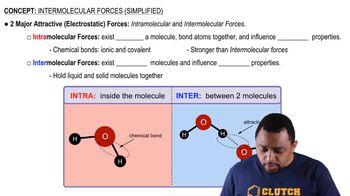
Intermolecular Forces
Intermolecular forces are the attractive forces between molecules that influence the physical state of a substance. In solids, these forces are strong, keeping molecules closely packed; in liquids, they are moderate, allowing for some movement; and in gases, they are weak, resulting in free movement of molecules. Understanding these forces is crucial for comparing them to kinetic energy in different states of matter.
Recommended video:
Guided course
Intermolecular vs Intramolecular Forces
Phase Changes
Phase changes refer to the transitions between solid, liquid, and gas states, which occur due to changes in temperature and pressure. During these changes, the balance between kinetic energy and intermolecular forces shifts, affecting the average energy of attraction. For instance, as a solid melts into a liquid, the kinetic energy increases, overcoming some intermolecular forces, which is essential for understanding the energy dynamics in different phases.
Recommended video:
Guided course
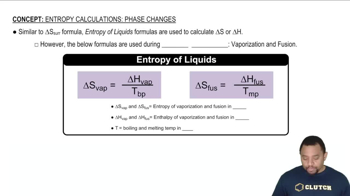
Entropy in Phase Changes
Related Practice
Textbook Question
2410
views
Textbook Question
The phase diagram of a hypothetical substance is
(b) What is the physical state of the substance under the following conditions? (i) T = 150 K, P = 0.2 atm; (ii) T = 100 K, P = 0.8 atm; (iii) T = 300K, P = 1.0atm. [Section 11.6]
978
views
Textbook Question
(c) What happens to a gas if you put it under extremely high pressure?
915
views
Textbook Question
List the three states of matter in order of (a) increasing molecular disorder
482
views
Textbook Question
At three different temperatures, T1, T2, and T3, the molecules in a liquid crystal align in these ways:
(a) At which temperature or temperatures is the substance in a liquid crystalline state? At those temperatures, which type of liquid crystalline phase is depicted?
595
views
1
rank
