
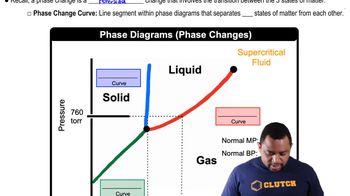
The phase diagram of a hypothetical substance is
(b) What is the physical state of the substance under the following conditions? (i) T = 150 K, P = 0.2 atm; (ii) T = 100 K, P = 0.8 atm; (iii) T = 300K, P = 1.0atm. [Section 11.6]

Verified step by step guidance
The phase diagram of a hypothetical substance is
(b) What is the physical state of the substance under the following conditions? (i) T = 150 K, P = 0.2 atm; (ii) T = 100 K, P = 0.8 atm; (iii) T = 300K, P = 1.0atm. [Section 11.6]
(c) What happens to a gas if you put it under extremely high pressure?
The molecules
have the same molecular formula (C3H8O) but different chemical structures. (b) Which molecule do you expect to have a larger dipole moment? [Sections 11.2 and 11.5]
List the three states of matter in order of (a) increasing molecular disorder
(a) How does the average kinetic energy of molecules com- pare with the average energy of attraction between mole- cules in solids, liquids, and gases?
Using this graph of CS2 data, determine (a) the approximate vapor pressure of CS2 at 30°C,