
At 900 K, the following reaction has πΎπ = 0.345: 2 SO2(π) + O2(π) β 2 SO3(π) In an equilibrium mixture the partial pressures of SO2 and O2 are 0.135 atm and 0.455 atm, respectively. What is the equilibrium partial pressure of SO3 in the mixture?
Ch.15 - Chemical Equilibrium

Brown15th EditionChemistry: The Central ScienceISBN: 9780137542970Not the one you use?Change textbook
Chapter 15, Problem 41b
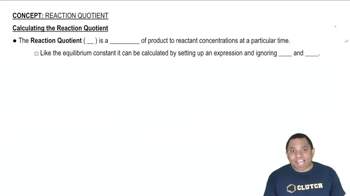
Indicate whether each of the following statements about the reaction quotient Q is true or false: (b) If ππ < πΎπ, the reaction needs to proceed to the right to reach equilibrium.
Verified step by step guidance1
Identify the relationship between the reaction quotient \( Q_c \) and the equilibrium constant \( K_c \).
Understand that \( Q_c \) is calculated using the concentrations of the reactants and products at any point in time, while \( K_c \) is calculated using concentrations at equilibrium.
Recognize that if \( Q_c < K_c \), it indicates that the concentration of products is less than what is required at equilibrium.
Conclude that the reaction will proceed in the forward direction (to the right) to increase the concentration of products and decrease the concentration of reactants until \( Q_c = K_c \).
Therefore, the statement is true: If \( Q_c < K_c \), the reaction needs to proceed to the right to reach equilibrium.

Verified video answer for a similar problem:
This video solution was recommended by our tutors as helpful for the problem above.
Video duration:
1mWas this helpful?
Key Concepts
Here are the essential concepts you must grasp in order to answer the question correctly.
Reaction Quotient (Q)
The reaction quotient, Q, is a measure of the relative concentrations of products and reactants at any point in a reaction. It is calculated using the same expression as the equilibrium constant (K), but with the current concentrations instead of equilibrium concentrations. Q helps determine the direction in which a reaction will proceed to reach equilibrium.
Recommended video:
Guided course
Reaction Quotient Q
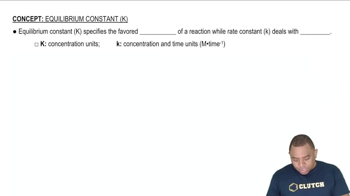
Equilibrium Constant (K)
The equilibrium constant, K, is a value that expresses the ratio of the concentrations of products to reactants at equilibrium for a given reaction at a specific temperature. If K is greater than 1, products are favored at equilibrium; if K is less than 1, reactants are favored. K is a crucial reference point for comparing with Q to predict the direction of the reaction.
Recommended video:
Guided course
Equilibrium Constant K
Le Chatelier's Principle
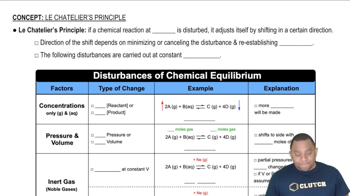
Le Chatelier's Principle states that if a system at equilibrium is disturbed, the system will adjust to counteract the disturbance and restore a new equilibrium. This principle helps explain how changes in concentration, pressure, or temperature affect the position of equilibrium, guiding predictions about whether a reaction will shift to the right (toward products) or left (toward reactants).
Recommended video:
Guided course
Le Chatelier's Principle
Related Practice
Textbook Question
1046
views
Textbook Question
Indicate whether each of the following statements about the reaction quotient Q is true or false: (a) The expression for ππ looks the same as the expression for πΎπ.
Textbook Question
At 100Β°C, the equilibrium constant for the reaction COCl2(π) β CO(π) + Cl2(π) has the value πΎπ = 2.19Γ10β10. Are the following mixtures of COCl2, CO, and Cl2 at 100Β°C at equilibrium? If not, indicate the direction that the reaction must proceed to achieve equilibrium.
(a) [COCl2] = 2.00Γ10β3 M, [CO] = 3.3Γ10β6 M, [Cl2] = 6.62Γ10β6 M
(b) [COCl2] = 4.50Γ10β2 M, [CO] = 1.1Γ10β7 M, [Cl2] = 2.25Γ10β6 M
(c) [COCl2] = 0.0100 M, [CO] = [Cl2] = 1.48Γ10β6 M
736
views
