
Addition of the indicator methyl orange to an unknown solution leads to a yellow color. The addition of bromthymol blue to the same solution also leads to a yellow color. (b) What is the range (in whole numbers) of possible pH values for the solution?
Ch.16 - Acid-Base Equilibria

Brown15th EditionChemistry: The Central ScienceISBN: 9780137542970Not the one you use?Change textbook
Chapter 16, Problem 37
By what factor does [H+] change for a pH change of (a) 2.00 units? (b) 0.50 units?
Verified step by step guidance1
pH is a measure of the hydrogen ion concentration in a solution, given by the formula: \( \text{pH} = -\log[\text{H}^+] \).
A change in pH of 2.00 units means the pH has either increased or decreased by 2.00.
If the pH decreases by 2.00 units, the concentration of \( \text{H}^+ \) ions increases. Conversely, if the pH increases by 2.00 units, the concentration of \( \text{H}^+ \) ions decreases.
The relationship between pH change and \( \text{H}^+ \) concentration change is logarithmic. A change of 1 pH unit corresponds to a tenfold change in \( \text{H}^+ \) concentration.
Therefore, a change of 2.00 pH units corresponds to a change in \( \text{H}^+ \) concentration by a factor of \( 10^2 \).

Verified video answer for a similar problem:
This video solution was recommended by our tutors as helpful for the problem above.
Video duration:
2mWas this helpful?
Key Concepts
Here are the essential concepts you must grasp in order to answer the question correctly.
pH Scale
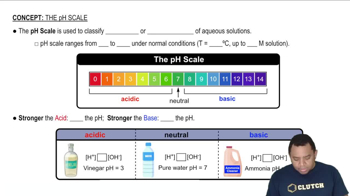
The pH scale measures the acidity or basicity of a solution, ranging from 0 to 14. A pH of 7 is neutral, below 7 is acidic, and above 7 is basic. Each unit change in pH represents a tenfold change in hydrogen ion concentration, meaning that a decrease in pH indicates an increase in acidity.
Recommended video:
Guided course
The pH Scale
Hydrogen Ion Concentration
Hydrogen ion concentration, denoted as [H+], is a measure of the amount of hydrogen ions present in a solution. It is directly related to pH, where a lower pH corresponds to a higher concentration of H+. For example, a change of 2.00 units in pH results in a change in [H+] by a factor of 10^2, or 100 times.
Logarithmic Relationship
The relationship between pH and hydrogen ion concentration is logarithmic, meaning that pH is the negative logarithm of the hydrogen ion concentration: pH = -log[H+]. This implies that small changes in pH can lead to significant changes in [H+], which is crucial for understanding how acidity affects chemical reactions and biological processes.
Related Practice
Textbook Question
627
views
Textbook Question
Deuterium oxide 1D2O, where D is deuterium, the hydrogen-2 isotope) has an ion-product constant, Kw, of 8.9 * 10-16 at 20 °C. Calculate 3D+4 and 3OD-4 for pure (neutral) D2O at this temperature.
2283
views
Textbook Question
Write the expression for the ion product constant for water, Kw.
645
views
Textbook Question
Calculate 3OH-4 for each of the following solutions, and indicate whether the solution is acidic, basic, or neutral: (a) 3H+4 = 0.0505 M
415
views
Textbook Question
Addition of phenolphthalein to an unknown colorless solution does not cause a color change. The addition of bromthymol blue to the same solution leads to a yellow color. (b) Which of the following can you establish about the solution: (i) A minimum pH, (ii) A maximum pH, or (iii) A specific range of pH values?
405
views
