
Predict the products of the following acid–base reactions, and predict whether the equilibrium lies to the left or to the right of the reaction arrow:
(a) NH4+(aq) + OH-(aq) ⇌
(b) CH3COO-(aq) + H3O+(aq) ⇌
(c) HCO3-(aq) + F-(aq) ⇌

Verified step by step guidancePredict the products of the following acid–base reactions, and predict whether the equilibrium lies to the left or to the right of the reaction arrow:
(a) NH4+(aq) + OH-(aq) ⇌
(b) CH3COO-(aq) + H3O+(aq) ⇌
(c) HCO3-(aq) + F-(aq) ⇌
Deuterium oxide 1D2O, where D is deuterium, the hydrogen-2 isotope) has an ion-product constant, Kw, of 8.9 * 10-16 at 20 °C. Calculate 3D+4 and 3OD-4 for pure (neutral) D2O at this temperature.
Predict the products of the following acid–base reactions, and predict whether the equilibrium lies to the left or to the right of the reaction arrow:
(a) O2-(aq) + H2O(l) ⇌
(b) CH3COOH(aq) + HS-(aq) ⇌
(c) NO2-(aq) + H2O(l) ⇌
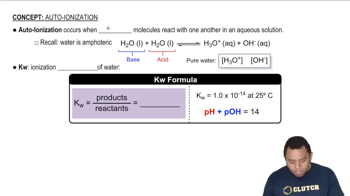
Write a chemical equation that illustrates the autoionization of water.
Calculate 3OH-4 for each of the following solutions, and indicate whether the solution is acidic, basic, or neutral: (a) 3H+4 = 0.0505 M
By what factor does [H+] change for a pH change of (a) 2.00 units? (b) 0.50 units?