
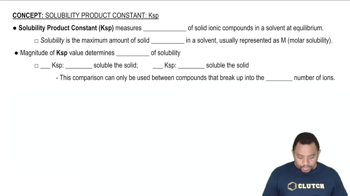
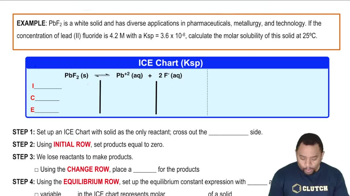
The solubility-product constant for barium permanganate, Ba1MnO422, is 2.5 * 10-10. Assume that solid Ba1MnO422 is in equilibrium with a solution of KMnO4. What concentration of KMnO4 is required to establish a concentration of 2.0 * 10-8 M for the Ba2 + ion in solution?

For each pair of compounds, use Ksp values to determine which has the greater molar solubility: (a) CdS or CuS (b) PbCO3 or BaCrO4 (c) Ni(OH)2 or NiCO3 (d) AgI or Ag2SO4.
Verified step by step guidance
Verified video answer for a similar problem:
Key Concepts
Solubility Product Constant (Ksp)
Molar Solubility
Dissociation of Ionic Compounds
The solubility of CaCO3 is pH dependent. (b) Use the Kb expression for the CO32- ion to determine the equilibrium constant for the reaction CaCO3(s) + H2O(l) ⇌ Ca2+(aq) + HCO3-(aq) + OH-(aq)
The solubility product constants of PbSO4 and SrSO4 are 6.3 * 10-7 and 3.2 * 10-7, respectively. What are the values of 3SO4 2 - 4, 3Pb2 + 4, and 3Sr2 + 4 in a solution at equilibrium with both substances?
Lead(II) carbonate, PbCO3, is one of the components of the passivating layer that forms inside lead pipes. (d) The EPA threshold for acceptable levels of lead ions in water is 15 ppb. Does a saturated solution of lead(II) carbonate produce a solution that exceeds the EPA limit?
Suppose you want to do a physiological experiment that calls for a pH 6.50 buffer. You find that the organism with which you are working is not sensitive to the weak acid H2A 1Ka1 = 2 * 10-2; Ka2 = 5.0 * 10-72 or its sodium salts. You have available a 1.0 M solution of this acid and a 1.0 M solution of NaOH. How much of the NaOH solution should be added to 1.0 L of the acid to give a buffer at pH 6.50? (Ignore any volume change.)
