The solubility product for Zn1OH22 is 3.0 * 10-16. The formation constant for the hydroxo complex, Zn1OH242 - , is 4.6 * 1017. What concentration of OH- is required to dissolve 0.015 mol of Zn1OH22 in a liter of solution?
Ch.17 - Additional Aspects of Aqueous Equilibria

Brown15th EditionChemistry: The Central ScienceISBN: 9780137542970Not the one you use?Change textbook
Chapter 17, Problem 105
The solubility product constants of PbSO4 and SrSO4 are 6.3 * 10-7 and 3.2 * 10-7, respectively. What are the values of 3SO4 2 - 4, 3Pb2 + 4, and 3Sr2 + 4 in a solution at equilibrium with both substances?
Verified step by step guidance1
Identify the dissolution reactions for PbSO_4 and SrSO_4: PbSO_4 (s) \(\rightleftharpoons\) Pb^{2+} (aq) + SO_4^{2-} (aq) and SrSO_4 (s) \(\rightleftharpoons\) Sr^{2+} (aq) + SO_4^{2-} (aq).
Write the expressions for the solubility product constants (K_{sp}) for each salt: K_{sp, PbSO_4} = [Pb^{2+}][SO_4^{2-}] and K_{sp, SrSO_4} = [Sr^{2+}][SO_4^{2-}].
Let the solubility of PbSO_4 be 's_1' and that of SrSO_4 be 's_2'. At equilibrium, [Pb^{2+}] = s_1 and [Sr^{2+}] = s_2, while [SO_4^{2-}] = s_1 + s_2.
Substitute the expressions for [Pb^{2+}], [Sr^{2+}], and [SO_4^{2-}] into the K_{sp} expressions: K_{sp, PbSO_4} = s_1(s_1 + s_2) and K_{sp, SrSO_4} = s_2(s_1 + s_2).
Solve the system of equations formed by the K_{sp} expressions to find the values of s_1, s_2, and [SO_4^{2-}] at equilibrium.

Verified video answer for a similar problem:
This video solution was recommended by our tutors as helpful for the problem above.
Video duration:
12mWas this helpful?
Key Concepts
Here are the essential concepts you must grasp in order to answer the question correctly.
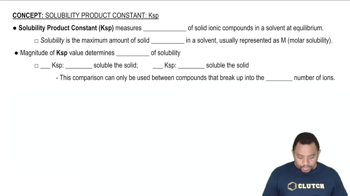
Solubility Product Constant (Ksp)
The solubility product constant (Ksp) is an equilibrium constant that applies to the solubility of sparingly soluble ionic compounds. It is defined as the product of the molar concentrations of the ions, each raised to the power of their coefficients in the balanced equation. For example, for PbSO4, Ksp = [Pb2+][SO4^2-]. Understanding Ksp is crucial for predicting the solubility of salts in solution.
Recommended video:
Guided course
Solubility Product Constant
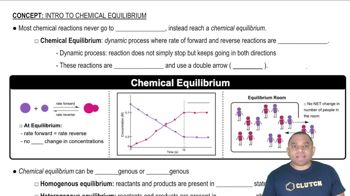
Equilibrium in Chemical Reactions
Equilibrium in chemical reactions occurs when the rates of the forward and reverse reactions are equal, resulting in constant concentrations of reactants and products. In the context of solubility, this means that the dissolution of a solid and the precipitation of its ions occur at the same rate. Analyzing equilibrium conditions helps determine the concentrations of ions in a saturated solution of salts like PbSO4 and SrSO4.
Recommended video:
Guided course
Chemical Equilibrium Concepts
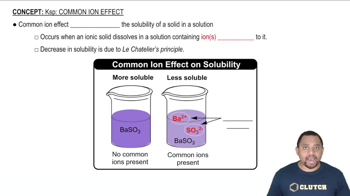
Common Ion Effect
The common ion effect refers to the decrease in solubility of a salt when a common ion is added to the solution. This phenomenon occurs because the presence of a common ion shifts the equilibrium position according to Le Chatelier's principle, favoring the formation of the solid phase. In this question, the presence of either Pb2+ or Sr2+ ions will influence the solubility of PbSO4 and SrSO4, respectively, affecting the equilibrium concentrations of the ions.
Recommended video:
Guided course
Common Ion Effect
Related Practice
Textbook Question
290
views
Textbook Question
The solubility-product constant for barium permanganate, Ba1MnO422, is 2.5 * 10-10. Assume that solid Ba1MnO422 is in equilibrium with a solution of KMnO4. What concentration of KMnO4 is required to establish a concentration of 2.0 * 10-8 M for the Ba2 + ion in solution?
953
views
Textbook Question
The solubility of CaCO3 is pH dependent. (b) Use the Kb expression for the CO32- ion to determine the equilibrium constant for the reaction CaCO3(s) + H2O(l) ⇌ Ca2+(aq) + HCO3-(aq) + OH-(aq)
1551
views
Textbook Question
The value of Ksp for Cd(OH)2 is 2.5 × 10⁻¹⁴. (a) What is the molar solubility of Cd(OH)2?
Textbook Question
For each pair of compounds, use Ksp values to determine which has the greater molar solubility: (a) CdS or CuS (b) PbCO3 or BaCrO4 (c) Ni(OH)2 or NiCO3 (d) AgI or Ag2SO4.
773
views