
Baking soda (sodium bicarbonate, NaHCO3) reacts with acids in foods to form carbonic acid (H2CO3), which in turn decomposes to water and carbon dioxide gas. In a cake batter, the CO2(g) forms bubbles and causes the cake to rise. (c) If 1/2 teaspoon of baking soda is indeed completely neutralized by the lactic acid in sour milk, calculate the volume of carbon dioxide gas that would be produced at 1 atm pressure, in an oven set to 350 F.
Ch.17 - Additional Aspects of Aqueous Equilibria

Brown15th EditionChemistry: The Central ScienceISBN: 9780137542970Not the one you use?Change textbook
Chapter 17, Problem 118
In nonaqueous solvents, it is possible to react HF to create H2F+. Which of these statements follows from this observation? (a) HF can act like a strong acid in nonaqueous solvents, (b) HF can act like a base in nonaqueous solvents, (c) HF is thermodynamically unstable, (d) There is an acid in the nonaqueous medium that is a stronger acid than HF.
Verified step by step guidance1
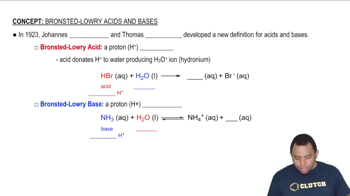
Identify the reaction: HF is reacting to form H2F+. This suggests that HF is donating a proton (H+).
Recognize that when a substance donates a proton, it is acting as an acid according to the Brønsted-Lowry acid-base theory.
Consider the implications of HF acting as an acid in a nonaqueous solvent. This means there must be a base present to accept the proton.
Evaluate the options: (a) suggests HF acts as a strong acid, which aligns with the observation of proton donation. (b) suggests HF acts as a base, which contradicts the proton donation. (c) suggests thermodynamic instability, which is not directly related to the observed reaction. (d) suggests the presence of a stronger acid, which is necessary for HF to donate a proton.
Conclude that the formation of H2F+ indicates HF is acting as an acid, and for it to donate a proton, there must be a stronger acid present in the nonaqueous medium, supporting option (d).

Verified video answer for a similar problem:
This video solution was recommended by our tutors as helpful for the problem above.
Video duration:
4mWas this helpful?
Key Concepts
Here are the essential concepts you must grasp in order to answer the question correctly.
Acid-Base Theory
Acid-base theory explains the behavior of substances in terms of proton (H+) transfer. In this context, an acid is a substance that donates protons, while a base accepts them. The ability of HF to form H2F+ in nonaqueous solvents suggests that it can act as a strong acid, donating a proton to another species in the solvent.
Recommended video:
Guided course
Bronsted-Lowry Acid-Base Theory
Solvent Effects on Acidity
The nature of the solvent significantly influences the acidity of a compound. In nonaqueous solvents, the solvation of ions differs from that in water, which can stabilize or destabilize certain species. This means that HF, typically a weak acid in water, may exhibit stronger acidic behavior in a nonaqueous environment, allowing it to form H2F+.
Recommended video:
Guided course
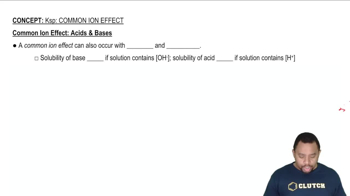
Common Ion Effect in Acids and Bases
Thermodynamic Stability
Thermodynamic stability refers to the relative energy levels of reactants and products in a chemical reaction. If HF can form H2F+, it implies that the resulting ion is more stable than HF in the nonaqueous medium. This observation can lead to conclusions about the relative strengths of acids in that medium, indicating that there may be stronger acids present that can facilitate this reaction.
Recommended video:
Guided course
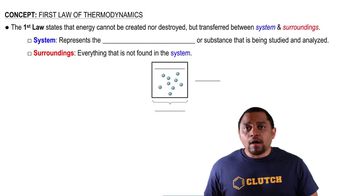
First Law of Thermodynamics
Related Practice
Textbook Question
9201
views
Textbook Question
A concentration of 10–100 parts per billion (by mass) of Ag+ is an effective disinfectant in swimming pools. However, if the concentration exceeds this range, the Ag+ can cause adverse health effects. One way to maintain an appropriate concentration of Ag+ is to add a slightly soluble salt to the pool. Using Ksp values from Appendix D, calculate the equilibrium concentration of Ag+ in parts per billion that would exist in equilibrium with (b) AgBr (c) AgI.
986
views
