
Ch.17 - Additional Aspects of Aqueous Equilibria
Brown - Chemistry: The Central Science 15th Edition
Brown15th EditionChemistry: The Central ScienceISBN: 9780137542970Not the one you use?Change textbook
Chapter 17, Problem 115b,c

A concentration of 10–100 parts per billion (by mass) of Ag+ is an effective disinfectant in swimming pools. However, if the concentration exceeds this range, the Ag+ can cause adverse health effects. One way to maintain an appropriate concentration of Ag+ is to add a slightly soluble salt to the pool. Using Ksp values from Appendix D, calculate the equilibrium concentration of Ag+ in parts per billion that would exist in equilibrium with (b) AgBr (c) AgI.

Verified step by step guidance
1
Identify the Ksp (solubility product constant) for AgI from Appendix D or a reliable source. The Ksp is a measure of the solubility of a compound in water and is given by the product of the concentrations of the ions each raised to the power of their stoichiometric coefficients in the balanced equation.
Write the dissolution equation for AgI. Since AgI dissociates into Ag+ and I- in solution, the equation can be written as: AgI(s) ⇌ Ag+(aq) + I-(aq).
Set up the expression for the Ksp of AgI using the dissolution equation. If 's' is the solubility of AgI in mol/L, then the Ksp expression is Ksp = [Ag+][I-] = s * s = s^2.
Solve for 's', the solubility of AgI, by taking the square root of the Ksp value. This will give you the equilibrium concentration of Ag+ in mol/L.
Convert the concentration of Ag+ from mol/L to parts per billion (ppb) by mass. This involves converting the molar concentration to grams per liter (using the molar mass of Ag), and then to grams per billion grams of water, considering the density of water.

Verified video answer for a similar problem:

This video solution was recommended by our tutors as helpful for the problem above.
Video duration:
5m
Was this helpful?

Key Concepts

Here are the essential concepts you must grasp in order to answer the question correctly.

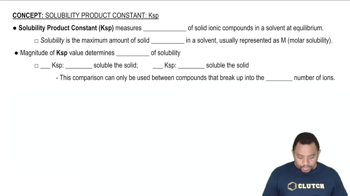
Solubility Product Constant (Ksp)

The solubility product constant (Ksp) is an equilibrium constant that applies to the solubility of sparingly soluble ionic compounds. It quantifies the extent to which a compound can dissolve in water, represented by the product of the molar concentrations of its ions, each raised to the power of their coefficients in the balanced equation. For example, for AgI, Ksp = [Ag+][I-], where [Ag+] and [I-] are the molar concentrations of silver and iodide ions at equilibrium.
Recommended video:
Guided course
01:47
Solubility Product Constant

Equilibrium Concentration

Equilibrium concentration refers to the concentration of reactants and products in a chemical reaction when the rates of the forward and reverse reactions are equal. In the context of the question, it is the concentration of Ag+ ions that remains constant when AgI is added to the swimming pool water, allowing for a stable level of disinfectant without exceeding safe limits.

Parts Per Billion (ppb)

Parts per billion (ppb) is a unit of measurement used to describe very dilute concentrations of substances. It indicates how many parts of a substance are present in one billion parts of a solution, often used in environmental science and chemistry to express trace levels of contaminants or active ingredients. In this case, it helps quantify the concentration of Ag+ ions in the swimming pool, ensuring it remains within the effective and safe range.