Consider a reaction A2(𝑔) + B2(𝑔) ⇌ 2 AB(𝑔), atoms of A shown in red in the diagram and atoms of B shown in blue. (a) If 𝐾𝑐 = 1, which box represents the system at equilibrium?
Ch.19 - Chemical Thermodynamics

Brown15th EditionChemistry: The Central ScienceISBN: 9780137542970Not the one you use?Change textbook
Chapter 19, Problem 4
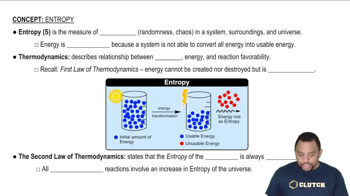
Predict the signs of ΔH and ΔS for this reaction. Explain your choice.
Verified step by step guidance1
Understand the reaction: Identify if the reaction is endothermic or exothermic. If the reaction absorbs heat, ΔH is positive. If it releases heat, ΔH is negative.
Consider the states of matter: Determine the change in entropy (ΔS) by considering the states of the reactants and products. If the reaction results in more disorder (e.g., solid to gas), ΔS is positive. If it results in less disorder (e.g., gas to solid), ΔS is negative.
Analyze the reaction components: Look at the number of moles of gaseous reactants and products. An increase in the number of gas molecules typically indicates an increase in entropy (positive ΔS).
Consider the nature of the reaction: If the reaction involves breaking strong bonds and forming weaker ones, it might be endothermic (positive ΔH). Conversely, forming stronger bonds from weaker ones might be exothermic (negative ΔH).
Summarize your findings: Based on the analysis of heat exchange and disorder, predict the signs of ΔH and ΔS for the reaction.
Key Concepts
Here are the essential concepts you must grasp in order to answer the question correctly.
Enthalpy (ΔH)
Enthalpy (ΔH) is a measure of the total heat content of a system at constant pressure. It indicates whether a reaction is exothermic (releases heat, ΔH < 0) or endothermic (absorbs heat, ΔH > 0). Understanding the enthalpy change helps predict the energy flow during a chemical reaction.
Entropy (ΔS)
Entropy (ΔS) is a measure of the disorder or randomness in a system. A positive ΔS indicates an increase in disorder, while a negative ΔS suggests a decrease in disorder. The change in entropy is crucial for predicting the spontaneity of a reaction, as reactions tend to favor higher entropy states.
Recommended video:
Guided course
Entropy in Thermodynamics
Gibbs Free Energy (ΔG)
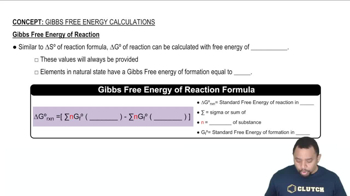
Gibbs Free Energy (ΔG) combines enthalpy and entropy to determine the spontaneity of a reaction at constant temperature and pressure. The relationship ΔG = ΔH - TΔS helps predict whether a reaction will occur spontaneously (ΔG < 0) or not (ΔG > 0). Understanding this concept is essential for analyzing the thermodynamic favorability of reactions.
Recommended video:
Guided course
Gibbs Free Energy of Reactions
Related Practice
Textbook Question
319
views
Textbook Question
Two different gases occupy the two bulbs shown here. Consider the process that occurs when the stopcock is opened, assuming the gases behave ideally. (d) How does the process affect the entropy of the surroundings?
627
views
Textbook Question
The accompanying diagram shows how entropy varies with temperature for a substance that is a gas at the highest temperature shown. (c) If this substance is a perfect crystal at T = 0 K, what is the value of S at this temperature?
494
views
Textbook Question
b. If energy can flow in and out of the system to maintain a constant temperature during the process, what can you say about the entropy change of the surroundings as a result of this process?
383
views