An atom of rhodium (Rh) has a diameter of about 2.7×10⁻⁸ cm. a. What is the radius of a rhodium atom in angstroms (Å) and in meters (m)?
Ch.2 - Atoms, Molecules, and Ions

Brown15th EditionChemistry: The Central ScienceISBN: 9780137542970Not the one you use?Change textbook
Chapter 2, Problem 20c
An atom of rhodium (Rh) has a diameter of about 2.7×10⁻⁸ cm. c. If you assume that the Rh atom is a sphere, what is the volume in m3 of a single atom?
Verified step by step guidance1
Convert the diameter of the Rhodium atom from centimeters to meters by multiplying by \(10^{-2}\), since there are 100 centimeters in a meter.
Calculate the radius of the Rhodium atom by dividing the diameter by 2.
Use the formula for the volume of a sphere, which is \(V = \frac{4}{3} \pi r^3\), where \(r\) is the radius of the sphere.
Substitute the radius value obtained in step 2 into the volume formula.
Ensure the final volume is expressed in cubic meters (m^3).

Verified video answer for a similar problem:
This video solution was recommended by our tutors as helpful for the problem above.
Video duration:
2mWas this helpful?
Key Concepts
Here are the essential concepts you must grasp in order to answer the question correctly.
Volume of a Sphere
The volume of a sphere can be calculated using the formula V = (4/3)πr³, where r is the radius of the sphere. To find the volume of a rhodium atom, one must first convert the diameter into radius by dividing it by two. This formula is essential for determining the space occupied by the atom when modeled as a sphere.
Recommended video:
Guided course
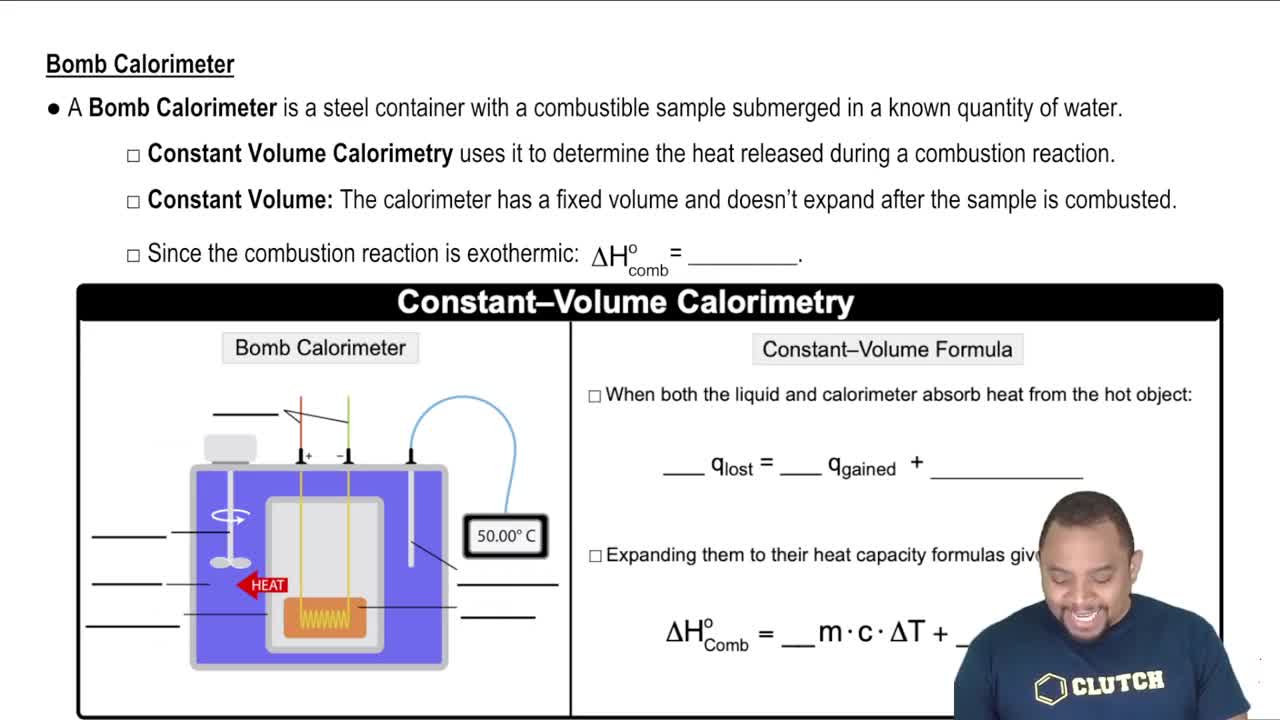
Constant-Volume Calorimetry
Unit Conversion
In chemistry, it is often necessary to convert units to ensure consistency, especially when dealing with measurements in different systems. In this case, the diameter of the rhodium atom is given in centimeters, but the final volume needs to be expressed in cubic meters (m³). Understanding how to convert between these units is crucial for accurate calculations.
Recommended video:
Guided course
Conversion Factors
Scientific Notation
Scientific notation is a way of expressing very large or very small numbers in a compact form, using powers of ten. For example, 2.7×10⁻⁸ cm represents a very small measurement. Familiarity with scientific notation is important in chemistry for handling measurements and calculations involving atomic and molecular scales.
Recommended video:
Guided course
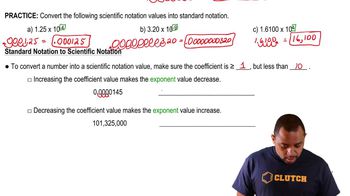
Standard Notation to Scientific Notation
Related Practice
Textbook Question
2
views
Textbook Question
Determine whether each of the following statements is true or false. d. The protons in the nucleus of the helium atom are held together by a force called the strong nuclear force.
4
views
Textbook Question
The radius of an atom of gold (Au) is about 1.35 Å. b. How many gold atoms would have to be lined up to span 1.0 mm?
4
views
Textbook Question
The radius of an atom of gold (Au) is about 1.35 Å. c. If the atom is assumed to be a sphere, what is the volume in cm3 of a single Au atom?
1
views
Textbook Question
Determine whether each of the following statements is true or false. a. The nucleus has most of the mass and comprises most of the volume of an atom.
3
views
Textbook Question
Determine whether each of the following statements is true or false. c. The number of electrons in an atom equals the number of neutrons in the atom.
3
views