An atom of rhodium (Rh) has a diameter of about 2.7×10⁻⁸ cm. a. What is the radius of a rhodium atom in angstroms (Å) and in meters (m)?
Ch.2 - Atoms, Molecules, and Ions

Brown15th EditionChemistry: The Central ScienceISBN: 9780137542970Not the one you use?Change textbook
Chapter 2, Problem 22c
Determine whether each of the following statements is true or false. c. The number of electrons in an atom equals the number of neutrons in the atom.
Verified step by step guidance1
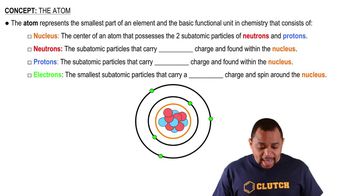
insert step 1> Identify the components of an atom: protons, neutrons, and electrons.
insert step 2> Recall that in a neutral atom, the number of electrons equals the number of protons.
insert step 3> Understand that the number of neutrons can vary, leading to different isotopes of the same element.
insert step 4> Compare the number of electrons and neutrons in an atom.
insert step 5> Conclude whether the statement 'The number of electrons in an atom equals the number of neutrons in the atom' is generally true or false based on the above understanding.
Key Concepts
Here are the essential concepts you must grasp in order to answer the question correctly.
Atomic Structure
Atoms are composed of three primary subatomic particles: protons, neutrons, and electrons. Protons and neutrons reside in the nucleus, while electrons orbit around the nucleus. The number of protons defines the element, while the number of electrons typically equals the number of protons in a neutral atom, leading to overall charge neutrality.
Recommended video:
Guided course
Atom Structure
Neutrons and Electrons
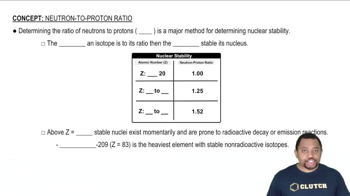
Neutrons are neutral particles found in the nucleus of an atom, while electrons are negatively charged particles that orbit the nucleus. The number of neutrons can vary in atoms of the same element, resulting in different isotopes, whereas the number of electrons in a neutral atom is equal to the number of protons, not neutrons.
Recommended video:
Guided course
Neutron-Proton Ratio
True/False Statements in Chemistry
In chemistry, evaluating statements as true or false often requires understanding the relationships between atomic particles. A statement claiming that the number of electrons equals the number of neutrons is generally false for most elements, as the number of neutrons can differ significantly from the number of electrons, especially in isotopes.
Recommended video:
Guided course
Introduction to Organic Chemistry Example
Related Practice
Textbook Question
2
views
Textbook Question
Determine whether each of the following statements is true or false. d. The protons in the nucleus of the helium atom are held together by a force called the strong nuclear force.
4
views
Textbook Question
An atom of rhodium (Rh) has a diameter of about 2.7×10⁻⁸ cm. c. If you assume that the Rh atom is a sphere, what is the volume in m3 of a single atom?
3
views
Textbook Question
Consider an atom of 10B. (a) How many protons, neutrons, and electrons does this atom contain?
1107
views
Textbook Question
Consider an atom of 10B. (b) What is the symbol of the atom obtained by adding one proton to 10B?
485
views
Textbook Question
Determine whether each of the following statements is true or false. a. The nucleus has most of the mass and comprises most of the volume of an atom.
3
views