
Textbook Question
All the structures shown here have the molecular formula C8H18. Which structures are the same molecule? (Hint: One way to answer this question is to determine the chemical name for each structure.)

 Verified step by step guidance
 04:44
04:44
 01:56
01:56 01:53
01:53All the structures shown here have the molecular formula C8H18. Which structures are the same molecule? (Hint: One way to answer this question is to determine the chemical name for each structure.)
Identify the element represented by each of the following symbols and give the number of protons and neutrons in each: (a) 7433X
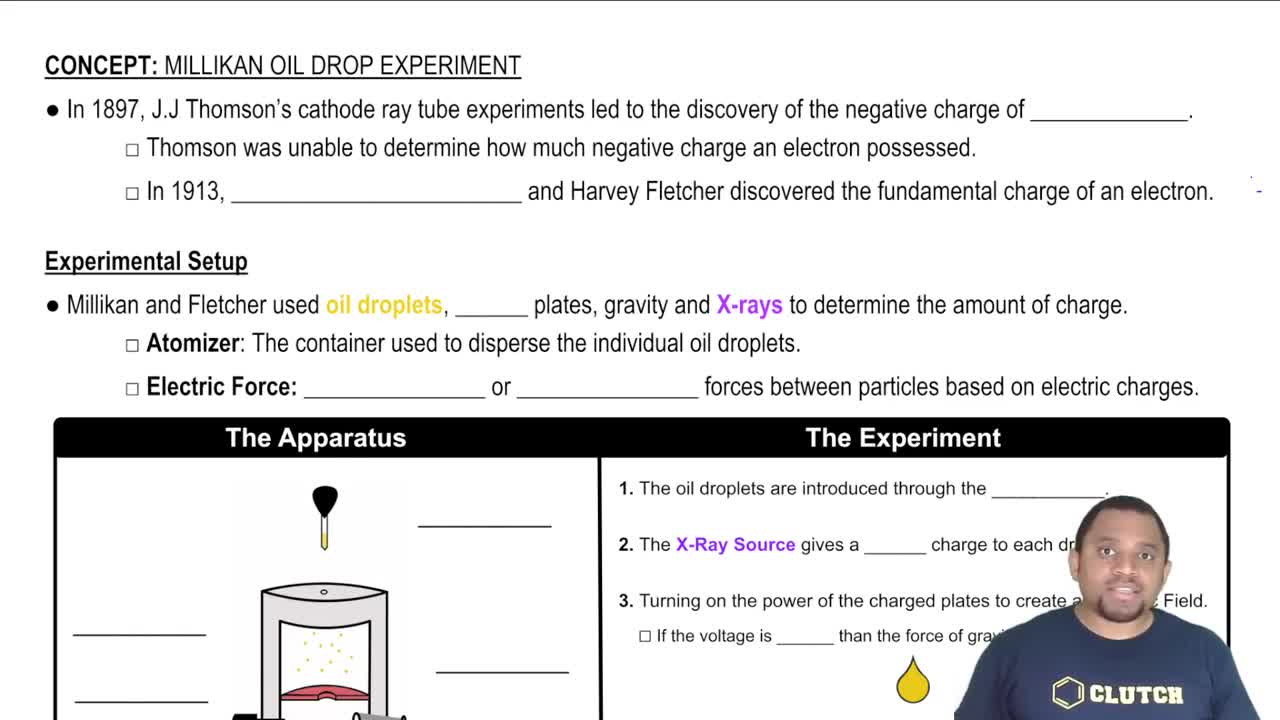
Suppose a scientist repeats the Millikan oil-drop experiment but reports the charges on the drops using an unusual (and imaginary) unit called the warmomb (wa). The scientist obtains the following data for four of the drops: Droplet Calculated Charge (wa) A 3.84⨉10−8 B 4.80⨉10−8 C 2.88⨉10−8 D 8.64⨉10−8 (b) From these data, what is the best choice for the charge of the electron in warmombs?
The natural abundance of 3He is 0.000137%. (a) How many protons, neutrons, and electrons are in an atom of 3He?
The natural abundance of 3He is 0.000137%. (b) Based on the sum of the masses of their subatomic particles, which is expected to be more massive, an atom of 3He or an atom of 3H (which is also called tritium)?
Suppose a scientist repeats the Millikan oil-drop experiment but reports the charges on the drops using an unusual (and imaginary) unit called the warmomb (wa). The scientist obtains the following data for four of the drops: Droplet Calculated Charge (wa) A 3.84⨉10−8 B 4.80⨉10−8 C 2.88⨉10−8 D 8.64⨉10−8 (c) Based on your answer to part (b), how many electrons are there on each of the droplets?