Ch.2 - Atoms, Molecules, and Ions
Brown - Chemistry: The Central Science 15th Edition
Brown15th EditionChemistry: The Central ScienceISBN: 9780137542970Not the one you use?Change textbook
Chapter 2, Problem 94b

The natural abundance of 3He is 0.000137%. (b) Based on the sum of the masses of their subatomic particles, which is expected to be more massive, an atom of 3He or an atom of 3H (which is also called tritium)?

Verified step by step guidance
1
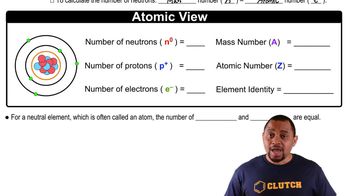
Identify the subatomic particles in each isotope: 3He has 2 protons, 1 neutron, and 2 electrons, while 3H has 1 proton, 2 neutrons, and 1 electron.
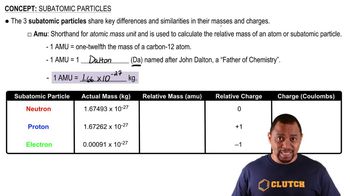
Calculate the mass of the protons in each isotope: Each proton has a mass of approximately 1.0073 amu.
Calculate the mass of the neutrons in each isotope: Each neutron has a mass of approximately 1.0087 amu.
Calculate the mass of the electrons in each isotope: Each electron has a mass of approximately 0.00055 amu.
Sum the masses of the subatomic particles for each isotope to determine which is more massive.

Verified video answer for a similar problem:

This video solution was recommended by our tutors as helpful for the problem above.
Video duration:
4m
Was this helpful?

Key Concepts

Here are the essential concepts you must grasp in order to answer the question correctly.

Subatomic Particles

Atoms are composed of subatomic particles: protons, neutrons, and electrons. Protons and neutrons reside in the nucleus and contribute to the atomic mass, while electrons are much lighter and orbit the nucleus. The number of protons defines the element, while the number of neutrons can vary, leading to different isotopes.
Recommended video:
Guided course
05:19
Subatomic Particles

Isotopes

Isotopes are variants of a chemical element that have the same number of protons but different numbers of neutrons. For example, both helium-3 (³He) and tritium (³H) are isotopes of hydrogen, with ³He having two protons and one neutron, while ³H has one proton and two neutrons. This difference in neutron count affects their mass and stability.
Recommended video:

Atomic Mass Calculation

The atomic mass of an isotope is calculated based on the sum of the masses of its subatomic particles. For ³He, the mass is derived from 2 protons and 1 neutron, while for ³H, it comes from 1 proton and 2 neutrons. Understanding how to calculate and compare these masses is essential for determining which isotope is more massive.
Related Practice
Textbook Question

The element oxygen has three naturally occurring isotopes, with 8, 9, and 10 neutrons in the nucleus, respectively. a. Write the full chemical symbols for these three isotopes.

2
views

Textbook Question

Identify the element represented by each of the following symbols and give the number of protons and neutrons in each: (a) 7433X

830
views
Textbook Question

The nucleus of 6Li is a powerful absorber of neutrons. It exists in the naturally occurring metal to the extent of 7.5%. In the era of nuclear deterrence, large quantities of lithium were processed to remove 6Li for use in hydrogen bomb production. The lithium metal remaining after removal of 6Li was sold on the market. (b) The atomic masses of 6Li and 7Li are 6.015122 and 7.016004 u, respectively. A sample of lithium depleted in the lighter isotope was found on analysis to contain 1.442% 6Li. What is the average atomic weight of this sample of the metal?

935
views
Textbook Question

Suppose a scientist repeats the Millikan oil-drop experiment but reports the charges on the drops using an unusual (and imaginary) unit called the warmomb (wa). The scientist obtains the following data for four of the drops: Droplet Calculated Charge (wa) A 3.84⨉10−8 B 4.80⨉10−8 C 2.88⨉10−8 D 8.64⨉10−8 (d) What is the conversion factor between warmombs and coulombs?

1459
views
Textbook Question

The natural abundance of 3He is 0.000137%. (a) How many protons, neutrons, and electrons are in an atom of 3He?

807
views
Textbook Question

Suppose a scientist repeats the Millikan oil-drop experiment but reports the charges on the drops using an unusual (and imaginary) unit called the warmomb (wa). The scientist obtains the following data for four of the drops: Droplet Calculated Charge (wa) A 3.84⨉10−8 B 4.80⨉10−8 C 2.88⨉10−8 D 8.64⨉10−8 (c) Based on your answer to part (b), how many electrons are there on each of the droplets?

846
views