
A method used by the U.S. Environmental Protection Agency (EPA) for determining the concentration of ozone in air is to pass the air sample through a 'bubbler' containing sodium iodide, which removes the ozone according to the following equation: O31g2 + 2 NaI1aq2 + H2O1l2¡ O21g2 + I21s2 + 2 NaOH1aq2 (b) How many grams of sodium iodide are needed to remove 1.3 mg of O3?

A mixture of N21g2 and H21g2 reacts in a closed container to form ammonia, NH31g2. The reaction ceases before either reactant has been totally consumed. At this stage 3.0 mol N2, 3.0 mol H2, and 3.0 mol NH3 are present. How many moles of N2 and H2 were present originally?
Verified step by step guidance
Verified video answer for a similar problem:
Key Concepts
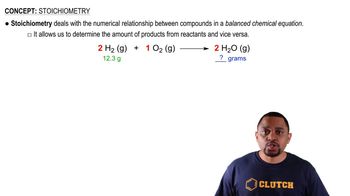
Stoichiometry
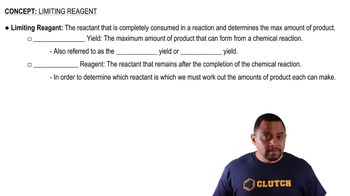
Limiting Reactant
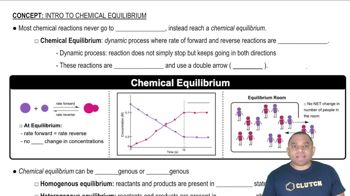
Chemical Equilibrium
When a mixture of 10.0 g of acetylene (C2H2) and 10.0 g of oxygen (O2) is ignited, the resulting combustion reaction produces CO2 and H2O. (c) How many grams of C2H2 are present after the reaction is complete?
The source of oxygen that drives the internal combustion engine in an automobile is air. Air is a mixture of gases, principally N2(79%) and O2(20%). In the cylinder of an automobile engine, nitrogen can react with oxygen to produce nitric oxide gas, NO. As NO is emitted from the tailpipe of the car, it can react with more oxygen to produce nitrogen dioxide gas. (b) Both nitric oxide and nitrogen dioxide are pollutants that can lead to acid rain and global warming; collectively, they are called 'NOx' gases. In 2009, the United States emitted an estimated 19 million tons of nitrogen dioxide into the atmosphere. How many grams of nitrogen dioxide is this?
The fat stored in a camel's hump is a source of both energy and water. Calculate the mass of H2O produced by the metabolism of 1.0 kg of fat, assuming the fat consists entirely of tristearin 1C57H110O62, a typical animal fat, and assuming that during metabolism, tristearin reacts with O2 to form only CO2 and H2O.
When a mixture of 10.0 g of acetylene (C2H2) and 10.0 g of oxygen (O2) is ignited, the resulting combustion reaction produces CO2 and H2O. (c) How many grams of CO2 and H2O are present after the reaction is complete?
