
The source of oxygen that drives the internal combustion engine in an automobile is air. Air is a mixture of gases, principally N2(79%) and O2(20%). In the cylinder of an automobile engine, nitrogen can react with oxygen to produce nitric oxide gas, NO. As NO is emitted from the tailpipe of the car, it can react with more oxygen to produce nitrogen dioxide gas. (c) The production of NOx gases is an unwanted side reaction of the main engine combustion process that turns octane, C8H18, into CO2 and water. If 85% of the oxygen in an engine is used to combust octane and the remainder used to produce nitrogen dioxide, calculate how many grams of nitrogen dioxide would be produced during the combustion of 500 g of octane.
Ch.3 - Chemical Reactions and Reaction Stoichiometry

Brown15th EditionChemistry: The Central ScienceISBN: 9780137542970Not the one you use?Change textbook
Chapter 3, Problem 108b
The source of oxygen that drives the internal combustion engine in an automobile is air. Air is a mixture of gases, principally N2(79%) and O2(20%). In the cylinder of an automobile engine, nitrogen can react with oxygen to produce nitric oxide gas, NO. As NO is emitted from the tailpipe of the car, it can react with more oxygen to produce nitrogen dioxide gas. (b) Both nitric oxide and nitrogen dioxide are pollutants that can lead to acid rain and global warming; collectively, they are called 'NOx' gases. In 2009, the United States emitted an estimated 19 million tons of nitrogen dioxide into the atmosphere. How many grams of nitrogen dioxide is this?
Verified step by step guidance1
Identify the given information: The problem states that 19 million tons of nitrogen dioxide (NO_2) were emitted.
Understand the conversion needed: We need to convert tons of NO_2 to grams.
Recall the conversion factors: 1 ton is equal to 2000 pounds, and 1 pound is equal to 453.592 grams.
Set up the conversion: Start with the given amount in tons and multiply by the conversion factors to convert to grams.
Perform the conversion: Multiply 19 million tons by 2000 to get pounds, then multiply by 453.592 to convert to grams.

Verified video answer for a similar problem:
This video solution was recommended by our tutors as helpful for the problem above.
Video duration:
3mWas this helpful?
Key Concepts
Here are the essential concepts you must grasp in order to answer the question correctly.
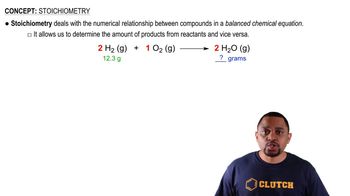
Stoichiometry
Stoichiometry is the branch of chemistry that deals with the quantitative relationships between the reactants and products in a chemical reaction. It allows chemists to calculate the amounts of substances involved in reactions based on balanced chemical equations. Understanding stoichiometry is essential for converting between moles, grams, and other units, which is crucial for solving problems related to chemical emissions.
Recommended video:
Guided course
Stoichiometry Concept
Molar Mass
Molar mass is the mass of one mole of a substance, typically expressed in grams per mole (g/mol). It is calculated by summing the atomic masses of all the atoms in a molecule. For nitrogen dioxide (NO2), the molar mass is approximately 46 g/mol, which is necessary for converting between moles of the gas and its mass in grams, particularly when calculating emissions.
Recommended video:
Guided course
Molar Mass Concept
Environmental Impact of NOx Gases
NOx gases, which include nitric oxide (NO) and nitrogen dioxide (NO2), are significant pollutants that contribute to environmental issues such as acid rain and global warming. Understanding their formation, sources, and effects is crucial for addressing air quality and climate change. The calculation of emissions, such as the 19 million tons of nitrogen dioxide mentioned, highlights the scale of their impact on the environment.
Recommended video:
Guided course
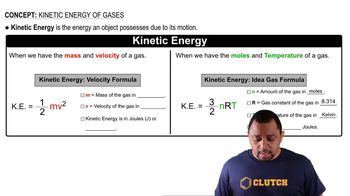
Kinetic Energy Formulas
Related Practice
Textbook Question
1600
views
Textbook Question
A mixture of N21g2 and H21g2 reacts in a closed container to form ammonia, NH31g2. The reaction ceases before either reactant has been totally consumed. At this stage 3.0 mol N2, 3.0 mol H2, and 3.0 mol NH3 are present. How many moles of N2 and H2 were present originally?
978
views
Textbook Question
When a mixture of 10.0 g of acetylene (C2H2) and 10.0 g of oxygen (O2) is ignited, the resulting combustion reaction produces CO2 and H2O. (c) How many grams of C2H2 are present after the reaction is complete?
799
views
Textbook Question
When a mixture of 10.0 g of acetylene (C2H2) and 10.0 g of oxygen (O2) is ignited, the resulting combustion reaction produces CO2 and H2O. (c) How many grams of CO2 and H2O are present after the reaction is complete?
394
views
