Imagine that you are climbing a mountain. Which of the following are state functions? b. The change in elevation during the climb
Ch.5 - Thermochemistry

Brown15th EditionChemistry: The Central ScienceISBN: 9780137542970Not the one you use?Change textbook
Chapter 5, Problem 35
Assume that 2 moles of water are formed according to the following reaction at constant pressure (101.3 kPa) and constant temperature (298 K): 2 H2(g) + O2(g) → 2 H2O(l). (b) Calculate _x001F_E for the reaction using your answer to (a).
Verified step by step guidance1
Step 1: Understand the reaction and the concept of enthalpy change (ΔE). The reaction given is 2 H2(g) + O2(g) → 2 H2O(l). The enthalpy change for a reaction at constant pressure is related to the heat absorbed or released.
Step 2: Use the standard enthalpy of formation values to calculate the enthalpy change for the reaction. The standard enthalpy of formation (ΔH_f^°) is the change in enthalpy when one mole of a compound is formed from its elements in their standard states.
Step 3: Write the expression for the enthalpy change of the reaction (ΔH_rxn) using the standard enthalpies of formation: ΔH_rxn = [2 * ΔH_f^°(H2O(l))] - [2 * ΔH_f^°(H2(g)) + ΔH_f^°(O2(g))].
Step 4: Recognize that the standard enthalpy of formation for elements in their standard state, such as H2(g) and O2(g), is zero. Therefore, the expression simplifies to ΔH_rxn = 2 * ΔH_f^°(H2O(l)).
Step 5: Use the known value of ΔH_f^°(H2O(l)) from a data table to calculate ΔH_rxn. This will give you the enthalpy change for the formation of 2 moles of water under the given conditions.
Key Concepts
Here are the essential concepts you must grasp in order to answer the question correctly.
Enthalpy Change (ΔH)
Enthalpy change (ΔH) is the heat content change of a system at constant pressure. It reflects the energy absorbed or released during a chemical reaction. In this context, calculating ΔH for the formation of water from hydrogen and oxygen involves using standard enthalpy values for the reactants and products to determine the overall energy change.
Standard Conditions
Standard conditions refer to a set of specific conditions used as a reference point in thermodynamics, typically defined as 1 atm pressure and 298 K (25°C). These conditions allow for consistent comparisons of thermodynamic data, such as enthalpy changes, across different reactions. Understanding these conditions is crucial for accurately calculating reaction energies.
Recommended video:
Guided course
Standard Reduction Potentials
Stoichiometry
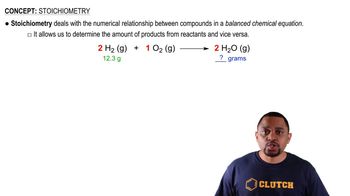
Stoichiometry is the calculation of reactants and products in chemical reactions based on the balanced chemical equation. It allows chemists to determine the proportions of substances involved in a reaction. In this case, knowing that 2 moles of water are produced from 2 moles of hydrogen and 1 mole of oxygen is essential for calculating the enthalpy change per mole of water formed.
Recommended video:
Guided course
Stoichiometry Concept
Related Practice
Textbook Question
2
views
Textbook Question
Imagine that you are climbing a mountain. Which of the following are state functions? a. The distance you walk during your climb to the top
2
views
Textbook Question
The complete combustion of ethanol, C2H5OH(l), to form H2O(g) and CO2(g) at constant pressure releases 1235 kJ of heat per mole of C2H5OH. b. Draw an enthalpy diagram for the reaction.
1
views
Textbook Question
How much work (in J) is involved in a chemical reaction if the volume decreases from 5.00 to 1.26 L against a constant pressure of 0.857 atm?
4
views
Textbook Question
A gas is confined to a cylinder under constant atmospheric pressure, as illustrated in Figure 5.4. When 0.49 kJ of heat is added to the gas, it expands and does 214 J of work on the surroundings. What are the values of H and E for this process?
3137
views