Imagine that you are climbing a mountain. Which of the following are state functions? b. The change in elevation during the climb
Ch.5 - Thermochemistry

Brown15th EditionChemistry: The Central ScienceISBN: 9780137542970Not the one you use?Change textbook
Chapter 5, Problem 36
Suppose that the gas-phase reaction 2 NO(g) + O2(g) → 2 NO2(g) were carried out in a constant-volume container at constant temperature. (a) Would the measured heat change represent _x001F_H or _x001F_E? (b) If there is a difference, which quantity is larger for this reaction? (c) Explain your answer to part (b).
Verified step by step guidance1
Step 1: Understand the difference between enthalpy change (ΔH) and internal energy change (ΔE). ΔH is the heat change at constant pressure, while ΔE is the heat change at constant volume.
Step 2: Recognize that the problem states the reaction occurs in a constant-volume container, which means the measured heat change represents ΔE, the change in internal energy.
Step 3: Recall the relationship between ΔH and ΔE: ΔH = ΔE + ΔnRT, where Δn is the change in moles of gas, R is the ideal gas constant, and T is the temperature in Kelvin.
Step 4: Calculate Δn for the reaction: 2 NO(g) + O2(g) → 2 NO2(g). The change in moles of gas, Δn, is (moles of products) - (moles of reactants) = 2 - (2 + 1) = -1.
Step 5: Since Δn is negative, ΔH = ΔE + ΔnRT will be less than ΔE, meaning ΔE is larger than ΔH for this reaction.
Key Concepts
Here are the essential concepts you must grasp in order to answer the question correctly.
Enthalpy (_x001F_H)
Enthalpy is a thermodynamic quantity that represents the total heat content of a system at constant pressure. It accounts for the internal energy of the system plus the product of its pressure and volume. In reactions occurring at constant volume, the change in enthalpy can be related to heat transfer, but it is not directly measured since pressure is not constant.
Internal Energy (_x001F_E)
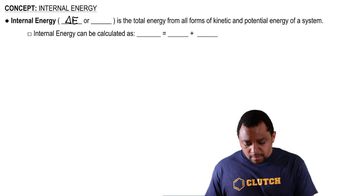
Internal energy is the total energy contained within a system, including kinetic and potential energies of the particles. For reactions occurring in a constant-volume container, the change in internal energy is equal to the heat exchanged, as no work is done on or by the system. This makes internal energy a crucial factor in understanding heat changes in gas-phase reactions.
Recommended video:
Guided course
Internal Energy
Work and Heat in Reactions
In chemical reactions, the distinction between heat and work is essential. At constant volume, no work is done by the system (since volume does not change), meaning that the heat change observed corresponds directly to the change in internal energy. Therefore, for the reaction in question, the change in internal energy (_x001F_E) will be greater than the change in enthalpy (_x001F_H) because _x001F_H includes the work term that is zero in this scenario.
Recommended video:
Guided course
Heat Capacity
Related Practice
Textbook Question
2
views
Textbook Question
The decomposition of Ca(OH)2 into CaO(s) and H2O at constant pressure requires the addition of 109 kJ of heat per mole of Ca(OH)2 . b. Draw an enthalpy diagram for the reaction.
2
views
Textbook Question
The complete combustion of ethanol, C2H5OH(l), to form H2O(g) and CO2(g) at constant pressure releases 1235 kJ of heat per mole of C2H5OH. b. Draw an enthalpy diagram for the reaction.
1
views
Textbook Question
How much work (in J) is involved in a chemical reaction if the volume decreases from 5.00 to 1.26 L against a constant pressure of 0.857 atm?
4
views
Textbook Question
A gas is confined to a cylinder under constant atmospheric pressure, as illustrated in Figure 5.4. When 0.49 kJ of heat is added to the gas, it expands and does 214 J of work on the surroundings. What are the values of H and E for this process?
3137
views