
Textbook Question
Write balanced equations that describe the formation of the following compounds from elements in their standard states, and then look up the standard enthalpy of formation for each substance in Appendix C: (a) NH4NO3(s)
1
views

 Verified step by step guidance
 02:03
02:03
 01:16
01:16Write balanced equations that describe the formation of the following compounds from elements in their standard states, and then look up the standard enthalpy of formation for each substance in Appendix C: (a) NH4NO3(s)
For each of the following compounds, write a balanced thermochemical equation depicting the formation of one mole of the compound from its elements in their standard states and then look up H °f for each substance in Appendix C. (b) FeCl3(s)
The concentration of alcohol 1CH3CH2OH2 in blood, called the 'blood alcohol concentration' or BAC, is given in units of grams of alcohol per 100 mL of blood. The legal definition of intoxication, in many states of the United States, is that the BAC is 0.08 or higher. What is the concentration of alcohol, in terms of molarity, in blood if the BAC is 0.08?
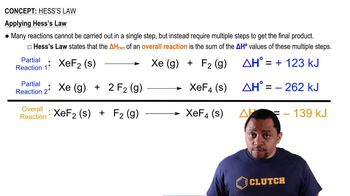
Calculate the enthalpy change for the reaction P4O6(s) + 2 O2(g) → P4O10(s) given the following enthalpies of reaction: P4(s) + 3 O2(g) → P4O6(s) ΔH = -1640.1 kJ P4(s) + 5 O2(g) → P4O10(s) ΔH = -2940.1 kJ
Consider the following hypothetical reactions: A → B ΔH = +30 kJ B → C ΔH = +60 kJ (b) Construct an enthalpy diagram for substances A, B, and C, and show how Hess's law applies.