
Ch.5 - Thermochemistry
Brown - Chemistry: The Central Science 15th Edition
Brown15th EditionChemistry: The Central ScienceISBN: 9780137542970Not the one you use?Change textbook
Chapter 5, Problem 59c

Under constant-volume conditions, the heat of combustion of benzoic acid (C6H5COOH) is 26.38 kJ/g. A 2.760-g sample of benzoic acid is burned in a bomb calorimeter. The temperature of the calorimeter increases from 21.60 to 29.93 °C. c. Suppose that in changing samples, a portion of the water in the calorimeter were lost. In what way, if any, would this change the heat capacity of the calorimeter?

Verified step by step guidance
1
Understand that the heat capacity of the calorimeter is the amount of heat required to raise the temperature of the entire calorimeter system by 1 degree Celsius.
Recognize that the calorimeter system includes both the calorimeter itself and the water it contains.
Consider that if water is lost from the calorimeter, the total mass of the system decreases.
Recall that heat capacity is an extensive property, meaning it depends on the amount of substance present.
Conclude that losing water would decrease the heat capacity of the calorimeter, as there is less mass to absorb the heat.

Key Concepts

Here are the essential concepts you must grasp in order to answer the question correctly.

Heat Capacity

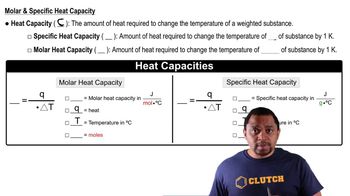
Heat capacity is the amount of heat required to change the temperature of a substance by one degree Celsius. In calorimetry, it is crucial for determining how much heat is absorbed or released during a chemical reaction. The heat capacity of a calorimeter is influenced by its mass and the specific heat of the materials it contains, which means any loss of water would alter its overall heat capacity.
Recommended video:
Guided course
02:19
Heat Capacity

Bomb Calorimeter

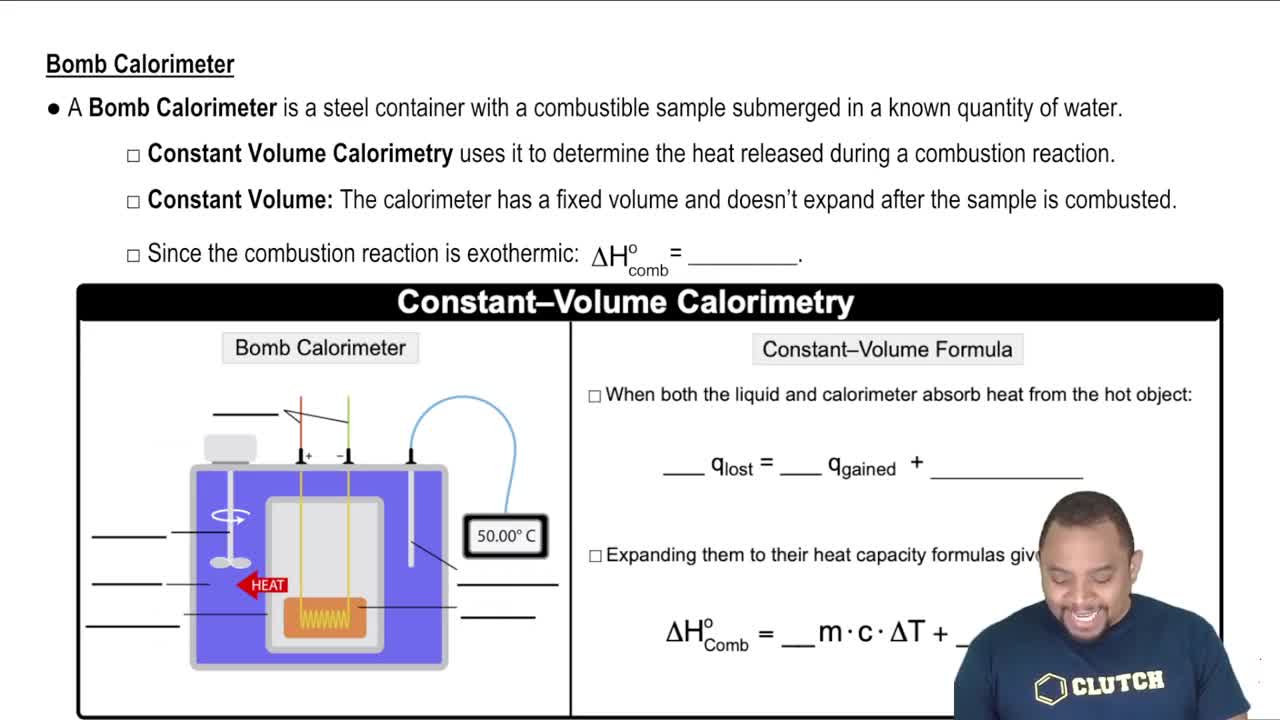
A bomb calorimeter is a device used to measure the heat of combustion of a substance under constant volume conditions. It consists of a sealed container (the bomb) where the reaction occurs, surrounded by a known quantity of water. The temperature change of the water is used to calculate the heat released by the combustion, making it essential to understand how changes in the system, like water loss, affect the results.
Recommended video:
Guided course
02:35
Constant-Volume Calorimetry

Specific Heat Capacity

Specific heat capacity is the amount of heat required to raise the temperature of one gram of a substance by one degree Celsius. Different substances have different specific heat capacities, which affects how they absorb and transfer heat. In the context of a calorimeter, if water is lost, the specific heat capacity of the remaining system changes, potentially leading to inaccurate measurements of heat transfer during the combustion process.
Recommended video:
Guided course
02:19
Heat Capacity
Related Practice
Textbook Question

A 1.800-g sample of phenol (C6H5OH) was burned in a bomb calorimeter whose total heat capacity is 11.66 kJ/°C. The temperature of the calorimeter plus contents increased from 21.36 to 26.37 °C. b. What is the heat of combustion per gram of phenol?

2
views
Textbook Question

A 2.200-g sample of quinone (C6H4O2) is burned in a bomb calorimeter whose total heat capacity is 7.854 kJ/°C. The temperature of the calorimeter increases from 23.44 to 30.57 °C. b. What is the heat of combustion per mole of quinone?

3
views
Textbook Question

A 1.800-g sample of phenol (C6H5OH) was burned in a bomb calorimeter whose total heat capacity is 11.66 kJ/°C. The temperature of the calorimeter plus contents increased from 21.36 to 26.37 °C. a. Write a balanced chemical equation for the bomb calorimeter reaction.

5
views
Textbook Question

The concentration of alcohol 1CH3CH2OH2 in blood, called the 'blood alcohol concentration' or BAC, is given in units of grams of alcohol per 100 mL of blood. The legal definition of intoxication, in many states of the United States, is that the BAC is 0.08 or higher. What is the concentration of alcohol, in terms of molarity, in blood if the BAC is 0.08?

2404
views
Textbook Question

Calculate the enthalpy change for the reaction P4O6(s) + 2 O2(g) → P4O10(s) given the following enthalpies of reaction: P4(s) + 3 O2(g) → P4O6(s) ΔH = -1640.1 kJ P4(s) + 5 O2(g) → P4O10(s) ΔH = -2940.1 kJ

1298
views
Textbook Question

Consider the following hypothetical reactions: A → B ΔH = +30 kJ B → C ΔH = +60 kJ (b) Construct an enthalpy diagram for substances A, B, and C, and show how Hess's law applies.

3
views