
Textbook Question
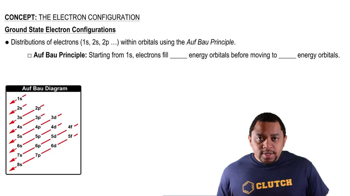
Write the condensed electron configurations for the following atoms and indicate how many unpaired electrons each has: (f) Lu.
425
views

 Verified step by step guidance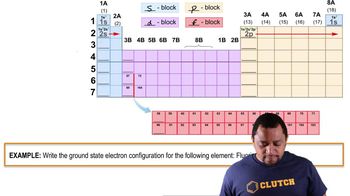
 01:33
01:33
 01:32
01:32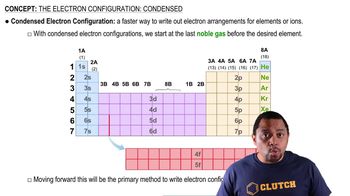 01:08
01:08Write the condensed electron configurations for the following atoms and indicate how many unpaired electrons each has: (f) Lu.
Consider the two waves shown here, which we will consider to represent two electromagnetic radiations: (b) What is the frequency of wave A?
Identify the specific element that corresponds to each of the following electron configurations and indicate the number of unpaired electrons for each: (d) 3Kr45s24d105p4.
Certain elements emit light of a specific wavelength when they are burned or heated in a non-luminous flame. Historically, chemists used such emission wavelengths to determine whether specific elements were present in a sample. Some characteristic wavelengths for a few of the elements are given in the following table:
Ag 328.1 nm Fe 372.0 nm
Au 267.6 nm K 404.7 nm
Ba 455.4 nm Mg 285.2 nm
Ca 422.7 nm Na 589.6 nm
Cu 324.8 nm Ni 341.5 nm
(c) When burned, a sample of an unknown substance is found to emit light of frequency 6.58 * 1014 s-1. Which of these elements is probably in the sample?
Consider the two waves shown here, which we will consider to represent two electromagnetic radiations: (a) What is the wavelength of wave A?
Identify the specific element that corresponds to each of the following electron configurations and indicate the number of unpaired electrons for each: (a) 1s22s2 (b) 1s22s22p4