

Ch.6 - Electronic Structure of Atoms
Brown - Chemistry: The Central Science 15th Edition
Brown15th EditionChemistry: The Central ScienceISBN: 9780137542970Not the one you use?Change textbook
Chapter 6, Problem 81a1

Consider the two waves shown here, which we will consider to represent two electromagnetic radiations: (a) What is the wavelength of wave A?
Two electromagnetic wave graphs illustrating wavelength; wave A's wavelength is 2.56 x 10^-6 m.

Verified step by step guidance
1
Identify the wave labeled as 'A' in the image. In this case, it is the wave labeled as (i).
Understand that the wavelength (\
\(\lambda\)\
\) is the distance between two consecutive peaks or troughs of the wave.
Observe the given scale in the image, which shows that the distance for wave (ii) is 2.56 x 10^-6 meters.
Count the number of wavelengths for wave (ii) within the given distance. In this case, there are two complete wavelengths for wave (ii).
Since wave (i) has twice the number of wavelengths as wave (ii) within the same distance, the wavelength of wave (i) is half of 2.56 x 10^-6 meters.

Verified video answer for a similar problem:

This video solution was recommended by our tutors as helpful for the problem above.
Video duration:
1m
Was this helpful?

Key Concepts

Here are the essential concepts you must grasp in order to answer the question correctly.

Wavelength

Wavelength is the distance between successive crests (or troughs) of a wave, typically measured in meters. It is a fundamental property of waves, including electromagnetic radiation, and is inversely related to frequency. The longer the wavelength, the lower the frequency, and vice versa. In the context of electromagnetic waves, wavelength determines the type of radiation, such as radio waves, visible light, or gamma rays.
Recommended video:
Guided course
00:31
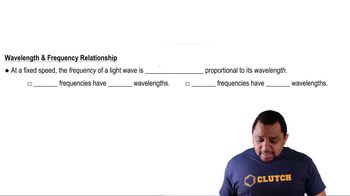
Frequency-Wavelength Relationship

Electromagnetic Spectrum

The electromagnetic spectrum encompasses all types of electromagnetic radiation, arranged by wavelength or frequency. It includes a range of waves from radio waves with long wavelengths to gamma rays with very short wavelengths. Understanding where a specific wavelength falls within this spectrum helps in identifying its properties and applications, such as communication, medical imaging, or heating.

Wave Properties

Waves exhibit several key properties, including amplitude, frequency, and wavelength. Amplitude refers to the height of the wave, indicating its energy, while frequency is the number of cycles that pass a point per second. These properties are interrelated; for instance, a wave's speed is the product of its frequency and wavelength. Understanding these properties is essential for analyzing wave behavior and interactions.
Recommended video:
Guided course
02:54
Physical Properties
Related Practice
Textbook Question

In August 2011, the Juno spacecraft was launched from Earth with the mission of orbiting Jupiter, arriving nearly five years later in July of 2016. The distance between the two planets varies depending on where each planet is in its orbit, but at the closest, the distance between Jupiter and Earth is 391 million miles. What is the minimum amount of time it takes for a transmitted signal from Juno to reach the Earth?

3
views
Textbook Question

Consider the two waves shown here, which we will consider to represent two electromagnetic radiations: (b) What is the frequency of wave A?

605
views
Textbook Question

Identify the specific element that corresponds to each of the following electron configurations and indicate the number of unpaired electrons for each: (d) 3Kr45s24d105p4.

387
views
Textbook Question

Certain elements emit light of a specific wavelength when they are burned or heated in a non-luminous flame. Historically, chemists used such emission wavelengths to determine whether specific elements were present in a sample. Some characteristic wavelengths for a few of the elements are given in the following table:

Ag 328.1 nm Fe 372.0 nm

Au 267.6 nm K 404.7 nm

Ba 455.4 nm Mg 285.2 nm

Ca 422.7 nm Na 589.6 nm

Cu 324.8 nm Ni 341.5 nm

(c) When burned, a sample of an unknown substance is found to emit light of frequency 6.58 * 1014 s-1. Which of these elements is probably in the sample?

3
views
Textbook Question

Identify the specific element that corresponds to each of the following electron configurations and indicate the number of unpaired electrons for each: (a) 1s22s2 (b) 1s22s22p4

574
views
Textbook Question

The following electron configurations represent excited states. Identify the element and write its ground-state condensed electron configuration. (b) 3Ar44s13d104p25p1

3
views