Chlorine reacts with oxygen to form Cl2O7. (c) Would you expect Cl2O7 to be more reactive toward H+1aq2 or OH-1aq2?
Ch.7 - Periodic Properties of the Elements

Brown15th EditionChemistry: The Central ScienceISBN: 9780137542970Not the one you use?Change textbook
Chapter 7, Problem 63b
Chlorine reacts with oxygen to form Cl2O7. (b) Write a balanced equation for the formation of Cl2O71l2 from the elements.
Verified step by step guidance1
Step 1: Identify the reactants and the product. In this case, the reactants are Chlorine (Cl2) and Oxygen (O2), and the product is Cl2O7.
Step 2: Write the unbalanced chemical equation. This is done by writing the reactants on the left side of the equation and the product on the right side of the equation. The unbalanced equation would be: Cl2 + O2 -> Cl2O7.
Step 3: Balance the equation. Start by balancing the Chlorine atoms. In this case, there are 2 Chlorine atoms on both sides of the equation, so they are already balanced.
Step 4: Next, balance the Oxygen atoms. There are 2 Oxygen atoms on the left side of the equation and 7 on the right side. To balance the Oxygen atoms, you can place a coefficient of 7/2 in front of the O2 on the left side of the equation. This gives: Cl2 + 7/2 O2 -> Cl2O7.
Step 5: However, in chemistry, we generally avoid using fractional coefficients. To get rid of the fraction, multiply every coefficient by 2. This gives the final balanced equation: 2 Cl2 + 7 O2 -> 2 Cl2O7.

Verified video answer for a similar problem:
This video solution was recommended by our tutors as helpful for the problem above.
Video duration:
1mWas this helpful?
Key Concepts
Here are the essential concepts you must grasp in order to answer the question correctly.
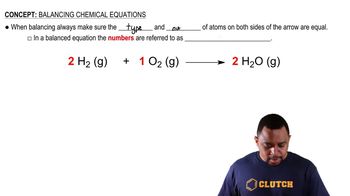
Balancing Chemical Equations
Balancing chemical equations is essential to ensure that the number of atoms of each element is the same on both sides of the equation. This reflects the law of conservation of mass, which states that matter cannot be created or destroyed in a chemical reaction. To balance an equation, coefficients are adjusted in front of the chemical formulas to achieve equal atom counts.
Recommended video:
Guided course
Balancing Chemical Equations
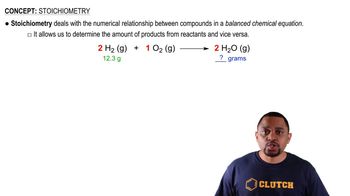
Stoichiometry
Stoichiometry involves the calculation of reactants and products in chemical reactions based on their molar ratios. It allows chemists to predict the amounts of substances consumed and produced in a reaction. Understanding stoichiometry is crucial for writing balanced equations and for practical applications in laboratory settings.
Recommended video:
Guided course
Stoichiometry Concept
Formation Reactions
A formation reaction is a specific type of chemical reaction where elements combine to form a compound. In the context of the question, the formation of Cl2O7 from chlorine and oxygen involves identifying the correct stoichiometric coefficients for each element. This concept is fundamental in understanding how compounds are synthesized from their elemental forms.
Related Practice
Textbook Question
543
views
1
rank
Textbook Question
Would you expect manganese(II) oxide, MnO, to react more readily with HCl(aq) or NaOH(aq)?
Textbook Question
Write balanced equations for the following reactions. a. barium oxide with water
Textbook Question
An element X reacts with oxygen to form XO2 and with chlorine to form XCl4. XO2 is a white solid that melts at high temperatures (above 1000 °C). Under usual conditions, XCl4 is a colorless liquid with a boiling point of 58 °C. (a) XCl4 reacts with water to form XO2 and another product. What is the likely identity of the other product?
718
views
Textbook Question
Arrange the following oxides in order of increasing acidity: CO2,CaO,Al2O3,SO3,SiO2,P2O5.
Textbook Question
Chlorine reacts with oxygen to form Cl2O7. (a) What is the name of this product (see Table 2.6)?
3662
views