Chlorine reacts with oxygen to form Cl2O7. (b) Write a balanced equation for the formation of Cl2O71l2 from the elements.
Ch.7 - Periodic Properties of the Elements

Brown15th EditionChemistry: The Central ScienceISBN: 9780137542970Not the one you use?Change textbook
Chapter 7, Problem 63c
Chlorine reacts with oxygen to form Cl2O7. (c) Would you expect Cl2O7 to be more reactive toward H+1aq2 or OH-1aq2?
Verified step by step guidance1
Identify the nature of Cl2O7: Cl2O7, or dichlorine heptoxide, is an acidic oxide because it is formed from the non-metal chlorine.
Understand the behavior of acidic oxides: Acidic oxides react with bases to form salts and water.
Consider the reaction with H+ (aq): Since Cl2O7 is an acidic oxide, it will not react with H+ (aq) because like substances do not react. Acidic oxides and H+ both have acidic properties.
Consider the reaction with OH- (aq): Cl2O7 will react with OH- (aq), which is a base, to form water and a salt (in this case, likely a chloride salt).
Conclude the reactivity: Cl2O7 is expected to be more reactive towards OH- (aq) than H+ (aq) because it can neutralize the base, leading to a chemical reaction.
Key Concepts
Here are the essential concepts you must grasp in order to answer the question correctly.
Acid-Base Chemistry
Acid-base chemistry involves the transfer of protons (H+) between species. In aqueous solutions, acids donate protons while bases accept them. Understanding the nature of Cl2O7, which can act as an acid, is crucial for predicting its reactivity with H+ or OH- ions.
Recommended video:
Guided course
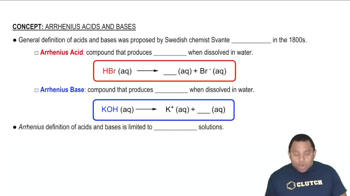
Arrhenius Acids and Bases
Reactivity of Oxides
Chlorine oxides, such as Cl2O7, exhibit unique reactivity patterns due to their molecular structure and oxidation states. Cl2O7 is a powerful oxidizing agent, and its reactivity can be influenced by the presence of acids or bases, making it essential to analyze how it interacts with H+ and OH-.
Lewis Acids and Bases
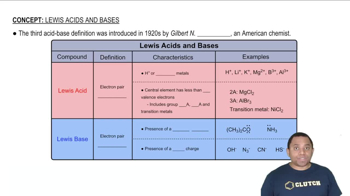
Lewis acid-base theory expands the definition of acids and bases beyond protons. A Lewis acid accepts an electron pair, while a Lewis base donates one. Cl2O7 can act as a Lewis acid, and understanding this concept helps predict its interactions with H+ (as a Lewis base) and OH- (as a Lewis base) in solution.
Recommended video:
Guided course
Lewis Acids and Bases
Related Practice
Textbook Question
1585
views
Textbook Question
Write balanced equations for the following reactions. a. barium oxide with water
Textbook Question
An element X reacts with oxygen to form XO2 and with chlorine to form XCl4. XO2 is a white solid that melts at high temperatures (above 1000 °C). Under usual conditions, XCl4 is a colorless liquid with a boiling point of 58 °C. (a) XCl4 reacts with water to form XO2 and another product. What is the likely identity of the other product?
718
views
Textbook Question
Arrange the following oxides in order of increasing acidity: CO2,CaO,Al2O3,SO3,SiO2,P2O5.
Textbook Question
Write balanced equations for the following reactions. c. sulfur trioxide with water
Textbook Question
Chlorine reacts with oxygen to form Cl2O7. (a) What is the name of this product (see Table 2.6)?
3662
views