
Textbook Question
Which neutral atom is isoelectronic with each of the following ions? Ga3+, Zr4+, Mn7+, I−, Pb2+.
1400
views
1
rank

 Verified step by step guidance
 01:19
01:19
 01:36
01:36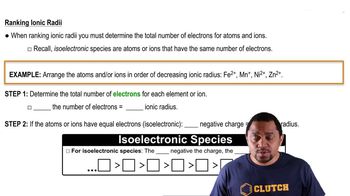 03:07
03:07Which neutral atom is isoelectronic with each of the following ions? Ga3+, Zr4+, Mn7+, I−, Pb2+.
Identify each statement as true or false: (b) Li+ is smaller than Li.
Using only the periodic table, arrange each set of atoms in order from largest to smallest: (a) Ar, As, Kr (b) Cd, Rb, Te (c) F, O, N.
For each set of atoms and ions, pick the smallest one.
a. I, I+, I−
b. Be2+, Ca2+, Mg2+
c. Fe, Fe2+, Fe3+
Using only the periodic table, arrange each set of atoms in order of increasing radius. b. In, Sn, As
Which of the following statements about the bonding atomic radii in Figure 7.7 is incorrect? (i) For a given period, the radii of the representative elements generally decrease from left to right across a period. (ii) The radii of the representative elements for the n = 3 period are all larger than those of the corresponding elements in the n = 2 period. (iii) For most of the representative elements, the change in radius from the n = 2 to the n = 3 period is greater than the change in radius from n = 3 to n = 4. (iv) The radii of the transition elements generally increase moving from left to right within a period. (v) The large radii of the Group 1 elements are due to their relatively small effective nuclear charges.