Ch.8 - Basic Concepts of Chemical Bonding
Brown - Chemistry: The Central Science 15th Edition
Brown15th EditionChemistry: The Central ScienceISBN: 9780137542970Not the one you use?Change textbook
Chapter 8, Problem 89c

(c) The measured dipole moment of BrCl is 0.57 D. If you assume the bond length in BrCl is the sum of the atomic radii, what are the partial charges on the atoms in BrCl using the experimental dipole moment?

Verified step by step guidance
1
Identify the formula for dipole moment: \( \mu = q \times d \), where \( \mu \) is the dipole moment, \( q \) is the partial charge, and \( d \) is the bond length.
Convert the dipole moment from Debye to Coulomb-meters if necessary. Note that 1 D = 3.33564 \(\times\) 10^{-30} \(\text{ C}\[\cdot\]\text{m}\).
Estimate the bond length \( d \) by adding the atomic radii of Br and Cl. Use a periodic table or a reliable source to find these values.
Rearrange the dipole moment formula to solve for the partial charge \( q \): \( q = \frac{\mu}{d} \).
Substitute the values of \( \mu \) and \( d \) into the equation to calculate the partial charge \( q \).

Verified video answer for a similar problem:

This video solution was recommended by our tutors as helpful for the problem above.
Video duration:
8m
Was this helpful?

Key Concepts

Here are the essential concepts you must grasp in order to answer the question correctly.

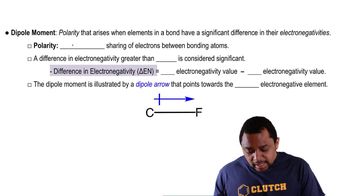
Dipole Moment

The dipole moment is a vector quantity that measures the separation of positive and negative charges in a molecule. It is calculated as the product of the charge and the distance between the charges. In the case of BrCl, the dipole moment indicates the polarity of the bond, with a value of 0.57 D suggesting a significant difference in electronegativity between bromine and chlorine.
Recommended video:
Guided course
01:25
Dipole Moment

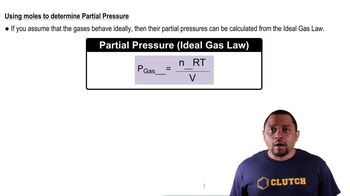
Partial Charges

Partial charges arise in polar covalent bonds when electrons are not shared equally between atoms due to differences in electronegativity. In BrCl, the chlorine atom, being more electronegative, will attract the shared electrons more strongly, resulting in a partial negative charge (δ-) on Cl and a partial positive charge (δ+) on Br. These charges can be calculated using the dipole moment and the bond length.
Recommended video:
Guided course
00:48
Partial Pressure Calculation

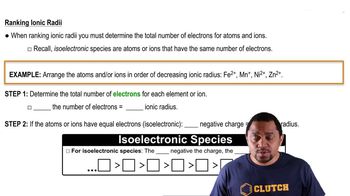
Bond Length and Atomic Radii

The bond length in a diatomic molecule like BrCl can be estimated by summing the atomic radii of the two atoms involved. The atomic radius is a measure of the size of an atom, typically defined as the distance from the nucleus to the outermost electron shell. For BrCl, using the atomic radii allows for an approximation of the distance over which the dipole moment acts, facilitating the calculation of partial charges.
Recommended video:
Guided course
03:07
Ranking Ionic Radii
Related Practice
Textbook Question

Consider the collection of nonmetallic elements O, P, Te, I, and B. (a) Which two would form the most polar single bond?

413
views

Textbook Question

A major challenge in implementing the 'hydrogen economy' is finding a safe, lightweight, and compact way of storing hydrogen for use as a fuel. The hydrides of light metals are attractive for hydrogen storage because they can store a high weight percentage of hydrogen in a small volume. For example, NaAlH4 can release 5.6% of its mass as H2 upon decomposing to NaH(s), Al(s), and H2(g). NaAlH4 possesses both covalent bonds, which hold polyatomic anions together, and ionic bonds. (c) Based on electronegativity differences, predict the identity of the polyatomic anion. Draw a Lewis structure for this ion.

424
views
Textbook Question

The triiodide ion, I3-, exists, whereas the corresponding ion with fluorine, F3-, does not. The I3- ion has a linear structure in which two outer I atoms are each bonded to a central I atom. Although I3- is a known ion, F3- is not.

c. Which of the following statements about the existence of I3- versus the nonexistence of F3- is or are true?

i. The Lewis structure of I3- shows 12 electrons around the central I atom.

ii. Elements from the second row of the periodic table generally do not form hypervalent molecules and ions.

iii. An I atom can form a hypervalent molecule or ion more readily than an F atom because of the larger size of the I atom.


2
views
Textbook Question

Structures A, B, and C show the connectivity of the atoms in three different molecules that are isomers of C3H4O. By completing the Lewis structures of these molecules, complete the information in the following table:

Isomer A Isomer B Isomer C

Number of single bonds

Number of double bonds

Number of triple bonds

Number of nonbonding pairs

Textbook Question

The substance chlorine monoxide, ClO(g), is important in atmospheric processes that lead to depletion of the ozone layer. The ClO molecule has an experimental dipole moment of 1.24 D, and the Cl—O bond length is 160 pm. (b) Based on the electronegativities of the elements, which atom would you expect to have a partial negative charge in the ClO molecule?

987
views
Textbook Question

(b) Using these partial charges and the atomic radii given in Figure 7.8, estimate the dipole moment of the molecule.

881
views