
Textbook Question
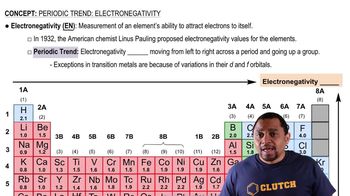
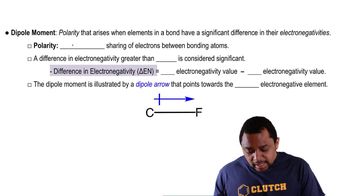
Consider the collection of nonmetallic elements O, P, Te, I, and B. (a) Which two would form the most polar single bond?
413
views

 Verified step by step guidance
 02:10
02:10
 01:25
01:25 00:36
00:36Consider the collection of nonmetallic elements O, P, Te, I, and B. (a) Which two would form the most polar single bond?
A major challenge in implementing the 'hydrogen economy' is finding a safe, lightweight, and compact way of storing hydrogen for use as a fuel. The hydrides of light metals are attractive for hydrogen storage because they can store a high weight percentage of hydrogen in a small volume. For example, NaAlH4 can release 5.6% of its mass as H2 upon decomposing to NaH(s), Al(s), and H2(g). NaAlH4 possesses both covalent bonds, which hold polyatomic anions together, and ionic bonds. (c) Based on electronegativity differences, predict the identity of the polyatomic anion. Draw a Lewis structure for this ion.
(c) The measured dipole moment of BrCl is 0.57 D. If you assume the bond length in BrCl is the sum of the atomic radii, what are the partial charges on the atoms in BrCl using the experimental dipole moment?
Construct a Born–Haber cycle for the formation of the hypothetical compound NaCl2, where the sodium ion has a 2+ charge (the second ionization energy for sodium is given in Table 7.2). (a) How large would the lattice energy need to be for the formation of NaCl2 to be exothermic?
(b) Using these partial charges and the atomic radii given in Figure 7.8, estimate the dipole moment of the molecule.