
Textbook Question
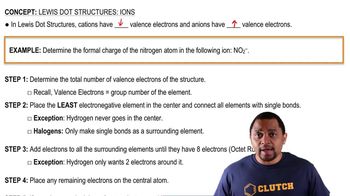
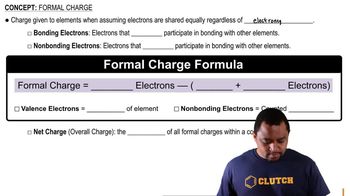
Predict the ordering, from shortest to longest, of the bond lengths in CO, CO2, and CO32- .
845
views

 Verified step by step guidance
 04:28
04:28
 01:53
01:53Predict the ordering, from shortest to longest, of the bond lengths in CO, CO2, and CO32- .
Consider a Lewis structure for SO3 that satisfies the octet rule. Which of the following statements is or are true?
i. SO3 has three equivalent resonance structures.
ii. There are one shorter and two longer S—O bond lengths in SO3.
iii. The S atom in SO3 has a nonzero formal charge.
Which one of these statements about formal charge is true? (a) Formal charge is the same as oxidation number. (b) To draw the best Lewis structure, you should minimize formal charge. (c) Formal charge takes into account the different electronegativities of the atoms in a molecule. (d) Formal charge is most useful for ionic compounds. (e) Formal charge is used in calculating the dipole moment of a diatomic molecule.
Which of the following statements about benzene, C6H6, is or are true?
i. Benzene has two equivalent resonance structures.
ii. There are no nonbonding pairs in the Lewis structure for benzene.
iii. Benzene has three short and three long C—C bonds.
Write Lewis structures that satisfy the octet rule for the following molecules and ions: a. NH4+, b. C2F4 (the two C atoms are bonded to one another), c. COCl2 (the Cl atoms are bonded to C), d. HSO3− (H is bonded to one of the O atoms), e. HNC (H and C are both bonded to N), f. ClO3−.