Ch.8 - Basic Concepts of Chemical Bonding
Brown - Chemistry: The Central Science 15th Edition
Brown15th EditionChemistry: The Central ScienceISBN: 9780137542970Not the one you use?Change textbook
Chapter 8, Problem 53

Write Lewis structures that obey the octet rule for each of the following, and assign oxidation numbers and formal charges to each atom: (a) OCS (b) SOCl2 (S is the central atom) (c) BrO3- (d) HClO2 (H is bonded to O)

Verified step by step guidance
1
Step 1: Identify the total number of valence electrons for each molecule or ion. For each atom, use the periodic table to determine the number of valence electrons and sum them up, adjusting for any charges in ions.
Step 2: Draw a skeletal structure for each molecule or ion. Typically, the least electronegative atom is placed in the center (except for hydrogen, which is always terminal). Connect the atoms with single bonds initially.
Step 3: Distribute the remaining valence electrons as lone pairs to satisfy the octet rule for each atom, starting with the outer atoms and moving towards the central atom. Remember that hydrogen only needs 2 electrons.
Step 4: If any atoms do not have a complete octet, consider forming double or triple bonds by converting lone pairs from adjacent atoms into bonding pairs.
Step 5: Assign oxidation numbers and formal charges. For oxidation numbers, use the rules based on electronegativity and known oxidation states. For formal charges, use the formula: Formal Charge = (Valence Electrons) - (Non-bonding Electrons) - 0.5*(Bonding Electrons).

Key Concepts

Here are the essential concepts you must grasp in order to answer the question correctly.

Lewis Structures

Lewis structures are diagrams that represent the bonding between atoms in a molecule and the lone pairs of electrons that may exist. They are essential for visualizing the arrangement of electrons and understanding molecular geometry. In constructing Lewis structures, one must account for the total number of valence electrons and ensure that atoms achieve stable electron configurations, often following the octet rule.
Recommended video:
Guided course
04:28
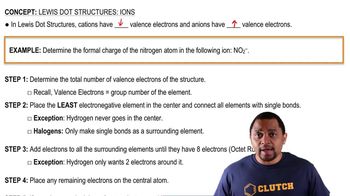
Lewis Dot Structures: Ions

Octet Rule

The octet rule is a chemical rule of thumb that states atoms tend to bond in such a way that they each have eight electrons in their valence shell, achieving a stable electronic configuration similar to that of noble gases. This rule is particularly applicable to main group elements and helps predict the formation of covalent bonds. However, there are exceptions, especially for elements in the third period and beyond, which can accommodate more than eight electrons.

Oxidation Numbers and Formal Charges

Oxidation numbers are assigned to atoms in a molecule to indicate the degree of oxidation or reduction, reflecting the hypothetical charge an atom would have if all bonds were ionic. Formal charge, on the other hand, is a calculation used to determine the charge of an atom in a molecule based on its valence electrons and the number of bonds it forms. Both concepts are crucial for assessing the stability of Lewis structures and ensuring that the total charge of the molecule is accurately represented.
Recommended video:
Guided course
01:53
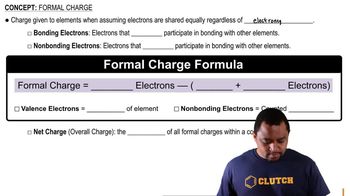
Formal Charge
Related Practice
Textbook Question

Predict the ordering, from shortest to longest, of the bond lengths in CO, CO2, and CO32- .

845
views

Textbook Question

Consider a Lewis structure for SO3 that satisfies the octet rule. Which of the following statements is or are true?

i. SO3 has three equivalent resonance structures.

ii. There are one shorter and two longer S—O bond lengths in SO3.

iii. The S atom in SO3 has a nonzero formal charge.

Textbook Question

Draw Lewis structures that satisfy the octet rule for the following molecules and ions: f. HOCl

2
views
Textbook Question

Which one of these statements about formal charge is true? (a) Formal charge is the same as oxidation number. (b) To draw the best Lewis structure, you should minimize formal charge. (c) Formal charge takes into account the different electronegativities of the atoms in a molecule. (d) Formal charge is most useful for ionic compounds. (e) Formal charge is used in calculating the dipole moment of a diatomic molecule.

1355
views
Textbook Question

For each of the following ions of nitrogen and oxygen, write a single Lewis structure that obeys the octet rule, and calculate the oxidation numbers and formal charges on all the atoms: c. NO2+.

2
views
Textbook Question

Write Lewis structures that satisfy the octet rule for the following molecules and ions: a. NH4+, b. C2F4 (the two C atoms are bonded to one another), c. COCl2 (the Cl atoms are bonded to C), d. HSO3− (H is bonded to one of the O atoms), e. HNC (H and C are both bonded to N), f. ClO3−.


2
views